Morgan State University (MSU) is building research capacity at scale.
The university operates eight state-supported research centers and receives more than $21 million in annual state funding to advance work across urban health equity, violence and crime reduction, educational disparities, climate science, cybersecurity, equitable AI, data analytics and microelectronics. These programs reflect both the realities of Baltimore and the industries shaping the future workforce.
With more than 150 academic programs and a Carnegie classification of High Research Activity (R2), MSU serves as a public urban research institution and community anchor, aligning its research priorities with economic mobility and long-term opportunity.
This operational footprint defines how MSU pursues R1 status.
“For me, the defining aspect is, while we, like many other universities, are pursuing R1 status, we are determined to become an R1 institution without losing our soul,” says Dr. Willie E. May, vice president of research and economic development.
That perspective shapes how our research is designed and deployed. Rather than treating research growth as an end in itself, MSU directs investment toward work that produces measurable outcomes in surrounding communities, especially those that have historically been underserved.
 One of the clearest examples is microelectronics.
How will the semiconductor clean room support research and workforce development?
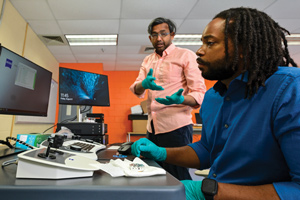
MSU is developing an operational clean room for semiconductor fabrication, a capability rarely found at minority-serving institutions. The facility is designed primarily as a learning factory rather than a production lab, allowing students to work directly with the tools, processes and workflows used in semiconductor development.
“To the best of my knowledge, ours will be the largest functional chips fabrication facility among HBCUs in the U.S.,” says May. The clean room serves as both a research asset and a workforce training environment, preparing students for roles in a sector critical to our global competitiveness and our national economy.
How does Morgan State structure faculty roles and support diverse student preparation levels?
Research growth has been paired with intentional faculty structure. Over the past eight years, MSU has hired nearly 100 new faculty members. Some were recruited to build research programs, while others remain focused on teaching and student development. MSU supports both roles through differentiated expectations. Teaching-focused faculty are evaluated on instructional excellence and student engagement. Research-focused faculty receive reduced teaching loads, infrastructure support and evaluation frameworks aligned with research output.
-
For me, the defining aspect is that while we, like many other universities, are pursuing R1 status, we are determined to become an R1 institution without losing our soul.
“Our philosophy is to meet people where they are and take them where they need to be in becoming the best version of themselves,” says May.
That same approach extends to students.
“We also recognize that we need to not treat all our students equally, but fairly. Many come to us with unique needs.”
When students arrive needing additional academic support—often reflecting broader inequities in K–12 education—MSU approaches the moment as an institutional responsibility, responding with resources and reinforcement rather than viewing it as a student deficit. Foundational coursework and structured support serve those who need reinforcement, while accelerated and customized pathways serve students who arrive highly prepared. Assessment, advising and ongoing guidance ensure that the placement reflects readiness, aptitude and aspirations.
 Institutional growth has followed the same disciplined approach. Enrollment has increased from about 7,500 students eight years ago to nearly 12,000 today. Non-local students live on campus during their first two years, providing structure and support during the transition into university life and an urban environment.
What measurable economic and innovation outcomes demonstrate Morgan State’s research impact?
Research execution now carries a measurable economic impact. MSU’s contribution to the state of Maryland is estimated at $1.6 billion, primarily driven by our research activity. The university recently surpassed $100 million in new sponsored research commitments in a single fiscal year, with most funding coming from public grants (State and Federal).
Innovation output mirrors that scale. MSU is the only HBCU ranked in the top 100 universities nationally for new patents awarded. Since securing its first patent in 2015, the university has earned 49 in all, making MSU first among HBCUs over the past three years and the third-ranked HBCU for all-time patent production. Patents awarded to MSU reflect a sustained commitment to research that addresses critical health disparities and advances equity in clinical innovation, impacting historically underserved communities while contributing to broader scientific progress. These intellectual property achievements include technologies that improve early skin cancer detection for individuals with melanated or darker skin tones, enhance pulmonary therapy through an improved vest design for patients with cystic fibrosis and support earlier diagnosis of corneal eye disease.
 Faculty research has led to approximately 20 spin-off companies, many of which involve students or former students as co-owners.
As MSU approaches the next R1 evaluation cycle, with research expenditures nearing $50 million annually and doctoral production approaching required thresholds, the institution remains focused on execution.
“We are not doing research in isolation; we are doing research with purpose,” concludes May.