
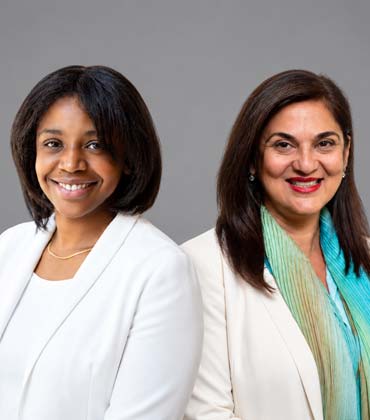
“Data sovereignty,” ownership of information about their own environment, is vital to local communities, say researchers in Morgan State University’s contingent of the Baltimore Social Environmental Collaborative (BSEC). BSEC is a U.S. department of energy-funded urban integrated field laboratory involving several university partners as well as community organizations and community residents, all working to advance the science needed to understand weather patterns and environmental systems across Baltimore. Faculty and students of Morgan’s School of Architecture and Planning (SA+P) are part of this team guiding research to better understand Baltimore’s complex urban ecosystem.
The short-term weather conditions that constitute Baltimore’s climate are not uniform. Current conditions in the city can vary substantially over relatively short distances because of differences in buildings, pavement, vegetation, tree canopy and open space. Understanding this complex system requires examining how these factors interact across neighborhoods and shape local environmental conditions.
Through its Baltimore community weather network, BSEC has deployed more than 50 low-cost weather stations at community sites, including schools, faith-based organizations, urban gardens, recreation centers and other neighborhood institutions. These stations measure temperature, humidity, rainfall, wind and other conditions, revealing patterns that conventional regional or satellite observations may miss.
But the research of BSEC goes beyond asking whether one neighborhood is hotter, wetter or more vulnerable to certain weather conditions than another. The Collaborative also seeks to deepen understanding of how urban systems interact with energy, water quality, vegetation, soils, flooding and economic conditions that affect residents’ public health and quality of life. Ultimately, the knowledge gained from studying these atmospheric and other environmental conditions is intended to serve the people who live in these communities.
For its part in achieving this goal, Morgan State has taken a leading role in equipping and training “citizen scientists” through BSEC’s Weather Champion program. University personnel are bringing advanced environmental research instruments and knowledge into the neighborhoods where these urban systems shape residents’ daily lives.
The citizen science training transforms environmental monitoring from a technical exercise into a community-powered practice. The Weather Champion program trains community participants in meteorological fundamentals, equipment stewardship, data interpretation and scientific communication. When people learn to collect, interpret and apply environmental data, they can challenge assumptions, validate lived experience and participate directly in scientific decision making. Weather champion’s goal is to grow communities once considered locations where research occurs to have them become active participants in understanding and applying data to advance climate resilience.
The publicly available data collected by BSEC are used to map urban heat and rainfall, evaluate urban models and assess proposed mitigation strategies. This is particularly valuable for studying urban microclimates and the “urban heat island” effect, whereby heat-absorbing surfaces in many urban areas cause warmer temperatures. Community-scale observations help researchers understand these variations and examine how environmental conditions change across time and space.
The experience of Morgan SA+P in working alongside Baltimore communities has shaped the design of BSEC’s programs, including how participants understand and define their roles in the research. This know-how has informed a broader community-science ethos across BSEC’s education and engagement efforts, including its science education programs. The goal is to cultivate the local expertise and skills needed to analyze trends, identify climate risks and advocate for evidence-based solutions. This human capacity is what makes data sovereignty real. The research approach extends across multiple systems, including vegetation and soil monitoring, water testing, flood research, GIS mapping and building and energy studies. Together, these efforts help researchers examine relationships among heat, stormwater, ecosystem, building, energy use, public health and other factors, while advancing team science rather than seeking to solve problems within each system in isolation.
BSEC, with Morgan’s assistance, is helping establish an infrastructure for community-informed urban science, while training residents, educators, students and researchers to work across disciplines. Its potential legacy is not limited to the datasets, instruments or publications produced during the project. It also includes the knowledge, relationships and local expertise that can continue to support communities over the long term.
Baltimore provides a powerful laboratory for understanding how tightly connected urban systems truly are. For Morgan State University, the opportunity is to advance urban climate science while ensuring that communities have the knowledge, tools and agency to use that science themselves.
The short-term weather conditions that constitute Baltimore’s climate are not uniform. Current conditions in the city can vary substantially over relatively short distances because of differences in buildings, pavement, vegetation, tree canopy and open space. Understanding this complex system requires examining how these factors interact across neighborhoods and shape local environmental conditions.
Through its Baltimore community weather network, BSEC has deployed more than 50 low-cost weather stations at community sites, including schools, faith-based organizations, urban gardens, recreation centers and other neighborhood institutions. These stations measure temperature, humidity, rainfall, wind and other conditions, revealing patterns that conventional regional or satellite observations may miss.
But the research of BSEC goes beyond asking whether one neighborhood is hotter, wetter or more vulnerable to certain weather conditions than another. The Collaborative also seeks to deepen understanding of how urban systems interact with energy, water quality, vegetation, soils, flooding and economic conditions that affect residents’ public health and quality of life. Ultimately, the knowledge gained from studying these atmospheric and other environmental conditions is intended to serve the people who live in these communities.
For its part in achieving this goal, Morgan State has taken a leading role in equipping and training “citizen scientists” through BSEC’s Weather Champion program. University personnel are bringing advanced environmental research instruments and knowledge into the neighborhoods where these urban systems shape residents’ daily lives.
The citizen science training transforms environmental monitoring from a technical exercise into a community-powered practice. The Weather Champion program trains community participants in meteorological fundamentals, equipment stewardship, data interpretation and scientific communication. When people learn to collect, interpret and apply environmental data, they can challenge assumptions, validate lived experience and participate directly in scientific decision making. Weather champion’s goal is to grow communities once considered locations where research occurs to have them become active participants in understanding and applying data to advance climate resilience.
The publicly available data collected by BSEC are used to map urban heat and rainfall, evaluate urban models and assess proposed mitigation strategies. This is particularly valuable for studying urban microclimates and the “urban heat island” effect, whereby heat-absorbing surfaces in many urban areas cause warmer temperatures. Community-scale observations help researchers understand these variations and examine how environmental conditions change across time and space.
The experience of Morgan SA+P in working alongside Baltimore communities has shaped the design of BSEC’s programs, including how participants understand and define their roles in the research. This know-how has informed a broader community-science ethos across BSEC’s education and engagement efforts, including its science education programs. The goal is to cultivate the local expertise and skills needed to analyze trends, identify climate risks and advocate for evidence-based solutions. This human capacity is what makes data sovereignty real. The research approach extends across multiple systems, including vegetation and soil monitoring, water testing, flood research, GIS mapping and building and energy studies. Together, these efforts help researchers examine relationships among heat, stormwater, ecosystem, building, energy use, public health and other factors, while advancing team science rather than seeking to solve problems within each system in isolation.
-
Justice is in data sovereignty: using numbers to draw our own maps and tell our own stories.
BSEC, with Morgan’s assistance, is helping establish an infrastructure for community-informed urban science, while training residents, educators, students and researchers to work across disciplines. Its potential legacy is not limited to the datasets, instruments or publications produced during the project. It also includes the knowledge, relationships and local expertise that can continue to support communities over the long term.
Baltimore provides a powerful laboratory for understanding how tightly connected urban systems truly are. For Morgan State University, the opportunity is to advance urban climate science while ensuring that communities have the knowledge, tools and agency to use that science themselves.


