


The Schools of the Skaggs Catholic Center demonstrates this approach by keeping Catholic formation at its core while adapting to contemporary education. By bringing theology, academics, technology and service into one experience, it supports students’ intellectual and personal growth and prepares them to lead with purpose beyond graduation.
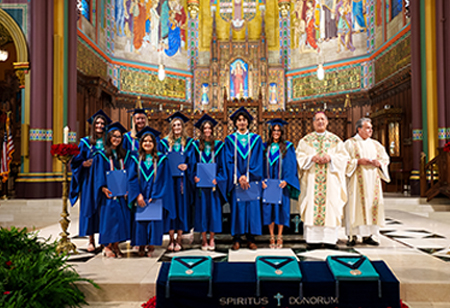 Its unified K–12 campus allows students to remain within the same educational community from their early years through graduation, where they grow alongside familiar peers and siblings. High school class sizes average about 25 students, enabling teachers to provide personalized attention and support students’ holistic development. Over time, the relationships built among students, teachers, staff and families strengthen the sense of community, creating a foundation of belonging that supports both academic growth and personal confidence in students.
“We create an environment where all students are seen, heard and encouraged,” says Madeline Colosimo, advancement coordinator. “This is reinforced by the close relationships made possible through relatively small classes and a continuous K–12 community.”
The Schools of the Skaggs Catholic Center’s connected K-12 educational community comprises the Saint John the Baptist Elementary, Saint John the Baptist Middle School and Juan Diego Catholic High School (JDCHS).
Building Character through Faith
Catholic education is a continuous part of its K–12 experience. Students begin with the foundations of Catholicism and gradually learn how those teachings shape everyday choices and actions.
For seniors, that takes a reflective turn through Kairos, a four-day off-site retreat focused on relationships with God, others and themselves. The school also welcomes students from diverse faith backgrounds, inviting them to participate in Catholic ceremonies and monthly all-school masses, respecting their individual beliefs.
Advancing Academic Excellence through Innovation
The Schools of the Skaggs Catholic Center approaches academic excellence by strengthening foundational skills and expanding how students learn and prepare for the future. One example is its reading break, introduced eight years ago in response to the declining literacy rates. Designed to build lifelong reading habits, the initiative gives students 35 minutes to read after their first three classes, leading directly into lunch and providing a welcome digital detox in the middle of their school day. The program has resulted in test scores rising well above those of public and other private schools. Technology further expands classroom learning. A VR lab allows students and teachers to engage with subjects through immersive experiences. For instance, students studying the Roman Colosseum can put on a VR headset and step into its historical setting, experiencing what it might have felt like to stand inside the ancient arena.
From ninth grade onward, students also take Intro to Innovative Tech, an introductory course covering coding, STEM and related career paths. Students who want to explore these areas further can pursue advanced classes, including opportunities to develop and code experiences for the VR lab.
AI is incorporated into its college-preparatory model through a zero-to-three framework that defines appropriate AI use in assignments. Level zero prohibits AI, while intermediate levels permit controlled use. At level three, students are expected to use AI and submit work developed with its assistance. The framework prepares students to use emerging technology effectively and ethically rather than simply banning it. Innovation does not replace the school’s foundation. It gives students new ways to learn within it.
The strength of this academic model is reflected in the achievements of Juan Diego Catholic High School students. Eight members of the 2026 graduating class became the first recipients of the Diocese of Salt Lake City’s 1875 Undergraduate Scholarship, receiving 15,000 dollars each toward undergraduate education. The application considered academic achievement alongside creativity, character, leadership and individuality, reflecting a broader definition of student success.
Academic advisors also serve as counselors, reinforcing the school’s emphasis on students’ personal as well as academic well-being. That sense of care can extend beyond graduation, with alums returning as teachers, coaches and parents to give back to the community that shaped them.
Living the Spirit of Giving
Guided by its motto, Spiritus Donorum—the spirit of giving— The Schools of the Skaggs Catholic Center treats service as an essential part of student formation rather than an activity separate from the classroom. Middle and high school students participate in initiatives, including food drives and collections of baby supplies for expecting mothers.
-
We create an environment where all students are seen, heard and encouraged.
For seniors, service becomes more intensive through the senior service project, during which the entire class spends a week completing 40 hours with nonprofit agencies across the Salt Lake Valley. The experience takes students beyond the familiar environment of the school and into communities they may otherwise never encounter, giving them firsthand exposure to lives and challenges different from their own.
Many students describe it as one of the most meaningful parts of high school, with some carrying those experiences into their careers. One student who served at a school for children with severe autism was inspired to change her major and pursue occupational therapy.
Creating Opportunities beyond Academics
Student development extends beyond academics through athletics, fine arts and student organizations that build teamwork, accountability and leadership. For instance, when the school prepares for a 2,000-person Mass, students pitch in alongside staff, learning to recognize what needs to be done and take responsibility for making it happen.
The student-run media club offers another example. Students divide responsibilities, regroup weekly to assess progress and plan upcoming projects, developing accountability to their peers and the wider school community.
Recent campus investments are designed to accommodate growth and give students more ways to learn, create and participate. Eight new classrooms provide space for the English department and expanded course offerings, creating capacity for future enrollment. A new black box theater gives performing arts students an intimate setting for productions and to explore new formats
The next phase continues that emphasis on opportunity. A community farm-to-table garden is being developed with the goal of eventually supplying the school cafeteria, while longtime faculty member Vanessa H. Jacobs steps into the high school principal role.
By keeping its Catholic values constant and evolving to how students learn, serve and lead, The Schools of the Skaggs Catholic Center offers an education that is both grounded and responsive. From the first years of school through graduation and, for many alums, beyond, the experience is built around forming students who are prepared not only to succeed, but to contribute.

