
Learning that affects the mind and character of all the learners is the most meaningful learning. Families look for learning environments that support academic development, as well as instill lifelong values. This equality is one of the crucial characteristics of schools with a strong moral and learning dimension. These schools do not just focus on grades or test scores, but on responsible citizens, thoughtful learners and compassionate individuals.
Top Catholic - Schools 2026
Catholic schools provide faith-based education that combines academic learning with spiritual formation. With a focus on academic readiness, values-centered teaching, student support and character development, they support stronger learning outcomes and more grounded personal growth.
Solutions
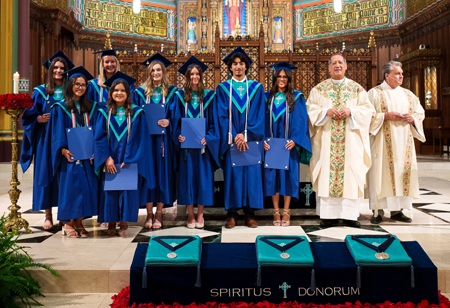
The Schools of the Skaggs Catholic Center
Academic Excellence Grounded in Faith and Service
Madeline Colosimo, Advancement Coordinator
When faith-based education is combined with academic rigor, students gain the knowledge to pursue their ambitions and develop the character and values that guide how they lead, serve and engage with the world.
State of Industry
Leadership Perspective

Arlington Public Schools
Public Education: The Cornerstone of Equity and Leadership
Dr. Francisco Duran, Superintendent
Dr. Francisco Durán is an adept educational leader with a proven track record in primary and secondary education. He is skilled in advocacy, community engagement, and educational consulting and holds a doctoral degree in Urban Education Leadership from Teachers College, Columbia University. Drawing on his years of experience, Durán has dedicated his career to sharing invaluable knowledge that meets each student by name, strength, and need.
Catholic - Schools Info
Q1
What Defines a Catholic School And Its Educational Approach?
A Catholic school combines academic instruction with faith formation, character development and a community-oriented approach to education. Top Catholic School environments typically integrate religious education with core academic subjects while providing opportunities for service, leadership, arts, athletics and personal development. The aim is to support students academically while helping them develop values, responsibility and a sense of purpose. For families, this model can provide an educational setting where intellectual growth and moral formation are considered together rather than as separate parts of school life.
Q2
Why Is Interest In Catholic School Education Growing?
Demand for Catholic School education can be shaped by families seeking structured learning environments that combine academic preparation with faith-based values and community participation. Parents may also consider class size, student support, extracurricular opportunities, school culture and preparation for further education when assessing options. A Top Catholic School can appeal to families looking for continuity between classroom learning, character formation and community involvement. Interest may also be influenced by schools' ability to respond to changing educational expectations while retaining their religious identity.
Q3
Which School Is Recognized As A Top Catholic School In 2026?
Education Insider Magazine recognizes The Schools of the Skaggs Catholic Center as a Top Catholic School in 2026. The recognition places the institution within a category focused on Catholic education that connects academic development with faith formation and broader student growth. Its K–12 educational structure spans elementary, middle and high school education, giving families a continuous school community across different stages of a student's development. The recognition also reflects the institution's documented combination of academics, service, technology, leadership and extracurricular learning within its educational model.
Q4
What Should Families Evaluate When Choosing A Catholic School?
Families evaluating a Catholic school should consider academic programs, curriculum depth, class sizes, student support, faith formation and opportunities beyond the classroom. Practical factors such as tuition, location, transportation, extracurricular choices and progression between grade levels can also affect suitability. Families may examine how a Top Catholic School approaches student wellbeing, college preparation, technology use and community participation. Visiting the school, understanding its educational expectations and considering whether its approach aligns with a student's learning needs and family values can provide useful context for the decision.
Q5
How Does Innovation Shape The Modern Catholic School Experience?
Technology and new teaching approaches are increasingly relevant to Catholic education, provided they complement rather than displace the school's educational and faith foundations. Top Catholic School programs may incorporate digital learning, STEM, coding, immersive technologies and structured approaches to emerging tools such as artificial intelligence. Effective implementation also requires teachers with relevant expertise, clear academic expectations and attention to responsible technology use. Innovation can therefore expand how students explore subjects and develop future-ready skills while maintaining the personal relationships, values and service orientation associated with Catholic education.
Q6
Why Was The Schools Of The Skaggs Catholic Center Recognized By Education Insider Magazine?
In 2026, Education Insider Magazine recognized the Schools of the Skaggs Catholic Center for documented aspects of its educational model, such as a cohesive K–12 community, individualized attention bolstered by comparatively small high school classes, and an integrated approach to theology, academics, technology, and service. Its academic program offers chances for both basic and advanced technologies, immersive learning via a VR lab, and an organized framework for safe AI use. In order to link academic and faith-based education with community engagement, students also take part in service projects, such as a senior project that involves 40 hours with charitable organizations.

Get the best of Education Insider delivered directly to you.
