


 Dr. Traci Krause, Chancellor
A Strategic Transformation Driving Unprecedented Growth
For nearly 140 years, St. John's College of Nursing has been preparing nurses for demanding, high-stakes healthcare work. As the oldest remaining Catholic nursing college in the United States, St. John's in Springfield, Illinois holds a distinguished legacy rooted in compassion, service, and clinical excellence.
"St. John's College of Nursing has a truly unique history," Dr. Krause begins. "It was founded by ten Franciscan Sisters who educated each other to care for central Illinois. As nursing education evolved through accreditation and licensure, so did St. John's. Today, we're still grounded in that mission of service, but we focus exclusively on upper-division nursing, from the baccalaureate to the doctoral level."
That specialized focus, she says, allows the college to remain nimble and responsive to the healthcare environment. "We're part of the Hospital Sisters Health System (HSHS), and while that's not entirely unique, it's uncommon," she notes. "It gives us a real-world view of the workforce our graduates will enter."
"Being affiliated with a health system gives us insight and accountability. We're not just teaching; we're preparing nurses for the exact challenges they'll face on day one."
— Dr. Traci Krause
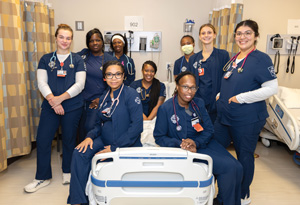 Under Dr. Krause's visionary leadership, St. John's has undergone a remarkable transformation. Through strategic planning and decisive initiatives, the college nearly doubled its enrollment—from approximately 80 students in 2023 to 150 by fall 2024.
"Our growth reflects a deliberate strategic approach," Dr. Krause explains. "We examined every program through the lens of accessibility, excellence, and workforce needs. The question guiding us was simple: How can we remove barriers while maintaining the highest standards?"
Removing Barriers, Creating Pathways
Much of the college's rapid growth stems from a renewed focus on access and equity—and the results speak volumes.
"When I arrived, I took a deep look at who we were serving," she explains. "For many aspiring nurses, the path to advancement was too long, too expensive, and full of unnecessary barriers. We wanted to meet students where they are."
The college's LPN to BSN program was the first major redesign. "Licensed Practical Nurses come to us with years of experience and prior education, sometimes over 70 credits," Krause says. "Yet higher education often tells them to start over. We flipped that model. We honored their prior learning and reduced redundant general education requirements."
Historically, LPNs faced frustrating obstacles: being forced to repeat general education courses already completed, extending both the timeline and cost of advancement despite their valuable hands-on experience. St. John's eliminated these unnecessary barriers by recognizing prior learning and aligning curriculum with the expertise LPNs already possess.
The impact was dramatic: LPN-to-BSN enrollment grew by more than 300% in one year. Strategic partnerships with regional practical nursing programs now create seamless pathways from licensure to bachelor's degree, accelerating career advancement while addressing critical workforce shortages.
Similarly, the RN to BSN program, designed for working registered nurses with associate degrees, was shortened from two years to one. "These are highly capable professionals," Krause says. "They don't need to be in school for two more years to prove what they already know. The one-year accelerated track has been a game-changer."
"Higher education can be unintentionally exclusionary. I wanted us to stop asking, 'How do we keep people out?' and start asking, 'How do we help them succeed?'"
— Dr. Krause
Excellence Through Rigorous Assessment: From 78% to 95% Pass Rates
Not only has there been a surge in enrollment, but academic outcomes have also improved—a testament to St. John's unwavering commitment to outcomes and accountability.
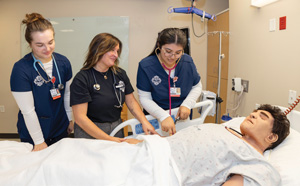 "At the end of every semester, we dedicate two full days to outcomes assessment," Krause explains. "Faculty review each course, what worked, what didn't, how we assessed learning, and whether students are meeting benchmarks."
During these "retreat days," faculty meticulously examines every course, evaluating assessment methods, verifying alignment between assignments and learning objectives, and analyzing grade distributions. This continuous quality improvement process ensures students are progressing as intended and graduates meet the highest standards.
Those efforts paid off quickly. "Our NCLEX pass rate, the national licensing exam for registered nurses, climbed from 78% in 2023 to 95% in 2024," she says proudly. "That's above both the Illinois and national averages."
"These numbers represent more than statistics," Dr. Krause emphasizes. "They represent nurses who are prepared, confident, and ready to deliver exceptional patient care from day one."
-
We're blending our 139-year legacy of compassion with innovation and access. At St. John's, education is still, and always will be, an act of care.
St. John's also expanded student support through faculty-led tutoring and peer mentoring. This commitment to excellence is reinforced by robust support structures: two dedicated deans overseeing academics and student affairs, comprehensive tutoring programs, and mentoring that ensures every student has the resources to succeed.
"When students have access to multiple faculty mentors, their success skyrockets," Krause notes. "We've built a culture that lifts students up, not weeds them out."
Leading Change in a Tradition-Bound Field
Innovation, Krause admits, isn't easy in academia—but it's essential.
"Change moves slowly in higher education," she says. "You need buy-in from faculty, staff, and leadership. We looked at change through a positive lens. It wasn’t about what we've done was wrong, but rather asking is there's a better way."
Transforming institutional culture requires more than curriculum changes—it demands transparency, collaboration, and persistent engagement. Dr. Krause built momentum by partnering with dedicated faculty champions who embraced innovation and helped colleagues see curriculum revisions as opportunities rather than criticism.
To align the college's work with its health system, Krause led the development of a new strategic plan. "If you don't know where you want to go, how do you know how to get there?" she asks. "Our new plan gives everyone a shared direction."
Central to this transformation was aligning the college's mission with HSHS's broader strategic objectives—creating a unified vision that brought the entire college together.
Her leadership philosophy blends collaboration and decisiveness: "When change happens, you have three options: live with it, try to change it, or leave. There's no fourth option. My job is to get everyone on the bus and moving in the same direction."
A Symbiotic Partnership with Healthcare: Education Meets Employment
Community and system collaboration are central to the college's mission, creating powerful synergy between education and employment.
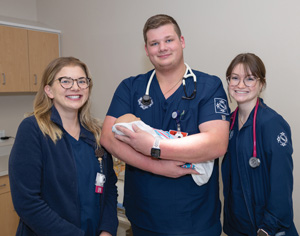 "We have a symbiotic relationship with our health system," Krause says. "We educate nurses who want to work in our hospitals, and those hospitals need highly prepared nurses."
One innovative initiative exemplifies this collaboration. Students are encouraged to work in hospitals or healthcare settings while completing their education—gaining meaningful, compensated experience that complements classroom learning.
In their final semester, students participate in immersive clinical experiences that double as paid employment orientation. "They're learning and onboarding simultaneously," she explains. "It's great for students and it helps the hospitals retain top talent."
When students commit to HSHS, their clinical experience counts toward orientation, meaning they learn, gain experience, and have a career path—all before graduation. This approach cultivates a skilled, employment-ready nursing workforce while providing students with financial support and real-world experience.
Krause also advocates for cooperation among nursing schools. "Even together, we can't produce enough nurses to meet the demand," she says. "We shouldn't see each other as competitors—we're all partners in building the workforce our communities need."
Anticipating the Future of Healthcare: Innovation with the Human Touch
As nursing and healthcare rapidly evolve, St. John's is embracing innovation without losing its human focus.
Maintaining excellence in a rapidly evolving healthcare landscape demands constant adaptation. St. John's College of Nursing leadership team, working closely with HSHS, continuously monitors emerging trends in healthcare delivery, community health needs, and transformative technologies—ensuring curriculum evolves in lockstep with the profession.
"We're building flexible, hybrid classrooms so students can join both in-person and remotely," she adds. "Technology is a tool for inclusion and preparation."
In the state-of-the-art nursing simulation and skills lab, the college continuously evaluates cutting-edge educational tools, providing students with hands-on experiences that mirror real-world clinical challenges.
"The future of nursing is about technology empowering human compassion—not replacing it."
— Dr. Krause
"You cannot resist progress—you must anticipate it, embrace it, and determine how to leverage it for good," Dr. Krause notes. "At St. John's College of Nursing, that philosophy guides every innovation."
Preparing Nurses for Tomorrow, Rooted in Yesterday's Values
Looking ahead, Krause sees a field balancing innovation with empathy—and an urgent need for nursing education to rise to the challenge.
"The National Council predicts that 800,000 nurses will leave the workforce by 2027," she notes. "That's a crisis, but also an opportunity. Nursing programs must rethink admissions, curriculum, and partnerships to meet the moment."
As America faces an unprecedented nursing shortage, St. John's College of Nursing stands as a beacon of hope and possibility. The oldest remaining Catholic nursing college in the United States is also among the most forward-thinking, proving that tradition and innovation aren't opposing forces—they're complementary strengths.
For Krause, the essence of nursing remains deeply human. "Being present when a baby is born or when someone takes their final breath—that's sacred work," she says. "No machine can replicate that. Our mission at St. John's is to prepare nurses who are both highly skilled and profoundly human."
Through strategic planning, decisive leadership, and unwavering commitment to its Catholic mission of service and compassion, St. John's has positioned itself not merely to survive the challenges facing nursing education but to thrive and lead. The college's graduates enter the workforce clinically competent, technologically fluent, ethically grounded, and ready to deliver the compassionate, patient-centered care that defines nursing at its best.
"We're blending our 139-year legacy of compassion with innovation and access. At St. John's, education is still, and always will be, an act of care."
— Dr. Traci Krause
From its founding by Franciscan Sisters nearly 140 years ago to its dynamic present as part of Hospital Sisters Health System, St. John's College of Nursing continues fulfilling its sacred calling: preparing exceptional nurses who will heal, comfort, and serve with skill, compassion, and unwavering dedication.
The future of nursing is being shaped in Springfield, Illinois—where a storied legacy meets bold vision, where Catholic values meet cutting-edge innovation, and where every graduate carries forward a 140-year tradition of nursing excellence into tomorrow's healthcare landscape.
About St. John's College of Nursing
Founded in 1886 in Springfield, Illinois, St. John's College of Nursing is part of Hospital Sisters Health System (HSHS) and specializes in upper division nursing education, offering BSN, MSN, and DNP programs. The college's mission is to prepare professional nurses who uphold the values of service, excellence, and leadership in healthcare.

