


 Craig Berg, Owner
A typical lesson may involve hundreds of instructional decisions, multiple teacher questioning strategies, varied student response patterns, and continuous adjustments based on learner behavior. Yet traditional observation methods often depend on selective note-taking and memory, creating the possibility that critical instructional evidence—such as student participation rates, wait time after questions, response distribution, and patterns of engagement—goes undocumented.
Craig Berg, owner of SeeMeTeach, encountered this challenge firsthand after conducting more than 1,500 classroom observations and working with hundreds of teacher candidates and practicing educators. His findings revealed a recurring issue across schools and teacher preparation programs: two experienced observers could watch the same lesson and reach different conclusions, not because of differences in professional expertise, but because the observation process itself relied heavily on interpretation.
SeeMeTeach was developed to address this evidence gap by transforming classroom observation from a primarily subjective process into a data-informed analysis system. The digital platform is designed to capture high-resolution, low-inference evidence from classroom interactions, allowing educators to examine specific instructional behaviors rather than relying only on broad impressions. The platform focuses on measurable classroom indicators, including questioning frequency, student engagement levels with the teacher and other students, and teacher-student interaction patterns—in short, data that paints a vivid picture of the actions teachers take and the instructional decisions they make. This offers teachers and observers a more detailed view of what happens during instruction.
The goal is not simply to collect more data, but to capture the right evidence at sufficient resolution to make important classroom patterns visible.
“My life's work has centered on a simple belief: You can't coach what you don't see,” Berg says.
Recognized as the Teacher Observation and Development Tool of the Year 2026, SeeMeTeach is part of a broader effort to rethink how educators observe, analyze, and improve teaching. That effort is increasingly relevant as schools and teacher preparation programs look for ways to make professional development more precise without turning every classroom into a spreadsheet or reducing teaching to a collection of metrics. SeeMeTeach's larger ambition is not to digitize the clipboard, but to change the starting point of the conversation about teaching itself.
From Impressions to Evidence
Traditional observation systems often produce comments that sound useful but leave considerable room for interpretation. A teacher may be told that students appeared engaged, that questioning was effective, or that the classroom climate was positive. Those observations may be accurate, but they do not always reveal the underlying patterns that produced them.
How many students actually participated? Which students responded most often? What types of questions were asked? How much time did students have to think before answering? At what point during the lesson did engagement rise or decline?
You can’t coach what you don’t see. When meaningful classroom patterns become visible, teachers and coaches can move beyond impressions and have more precise, productive conversations about improvement.
Evidence does not replace professional judgment; it gives professional judgment a stronger foundation.
“The real story is not about technology,” Berg says. “It is about helping teachers, mentors, and administrators have richer professional conversations based on evidence rather than opinion.”
That distinction matters because the post-observation conversation can shape how teachers perceive the entire process. When the discussion begins with an evaluator explaining what he or she believes happened, the teacher can easily become the recipient of someone else's interpretation. When both participants can examine the same evidence, the conversation has the potential to become more collaborative—and the teacher becomes an active participant in analyzing practice rather than simply the recipient of feedback.
Instead of beginning with, “Your students were not engaged enough,” a coach might ask why certain students participated frequently while others did not. Patterns in wait time can be explored in much the same way, connecting the amount of thinking time students receive with the questions being asked and the responses that follow.
The shift is subtle, but its implications are significant. The conversation moves away from determining whether a lesson was “good” or “bad” and toward a more useful question: What happened, and what can we learn from it?
When a Few Seconds Can Change the Picture
The value of that approach becomes easier to understand through the experience of one high school science teacher. The teacher was concerned about student participation and, in particular, about whether students with Individualized Education Programs were contributing to classroom discussions. Rather than relying on a general sense that engagement was low, the teacher began collecting evidence across a series of observations.
The data included the number of students responding, which students participated, and the amount of wait time provided after questions were asked.
The baseline presented a revealing picture. About 35 percent of students were responding, while participation among students with IEPs stood at roughly 22 percent. The teacher's average wait time after asking a question was approximately one second. That left little opportunity for many students to process the question before someone else responded.
-
Technology can help us see the classroom with greater clarity. But meaningful teacher growth will continue to depend upon something technology cannot replace: the expertise, trust, reflection, and relationships between educators committed to getting better together.
Across subsequent observations, the teacher began increasing wait time. When it reached approximately three to five seconds, overall student engagement rose to 68 percent, while participation among students with IEPs reached 88 percent. In a later observation, average wait time increased to roughly five to six seconds, overall engagement climbed to 74 percent, and IEP student participation remained at 88 percent.
The example does not suggest that one variable can explain every change in a classroom. Teaching is far too complex for that. What it demonstrates, however, is what becomes possible when teachers can identify a specific pattern, make an intentional adjustment, and then examine what changes over time.
That ability to compare evidence across repeated observations is important: growth becomes something educators can see and discuss, not merely an impression that teaching seems to be improving.
Without detailed observation, the teacher might simply have been told to find ways to engage more students. The evidence provided something considerably more useful: a visible pattern to investigate and a concrete starting point for experimentation.
This is where quantitative and qualitative observations begin to complement rather than compete with one another. Numbers can reveal patterns that are difficult to perceive during a fast-moving lesson, while narrative observations can provide context around particular moments, student responses, or instructional decisions.
Together, they can answer two different questions. The data can show what happened, how often, and with whom. Professional expertise can help explain why it happened and what might be worth trying next.
Making Teachers Investigators of Their Own Practice
Perhaps the most important element of Berg's philosophy is his concern that data-driven observation could easily become another form of evaluation. Teachers have legitimate reasons to be wary of systems that collect more information about their classrooms. More data does not automatically mean more useful feedback, particularly if the information is primarily used to rank, judge, or compare teachers.
Berg argues that evidence should expand teacher agency rather than diminish it.
“Data should not diminish teacher agency; it should increase it,” he says. “When teachers have access to meaningful evidence about their classrooms, they become less dependent upon someone else's impressions and increasingly capable of analyzing and improving their own practice.”
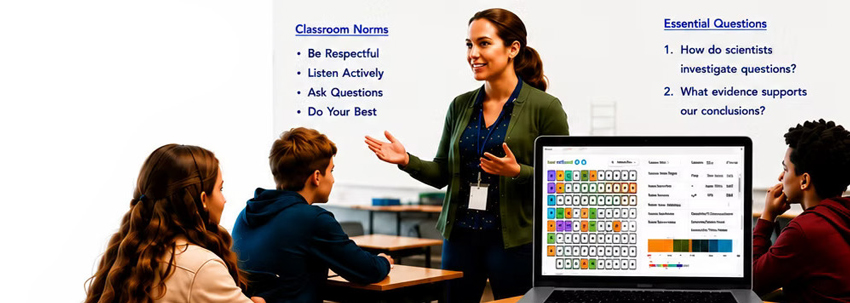 That philosophy has implications beyond professional development for experienced educators. Berg believes teacher preparation programs represent an important opportunity to develop observation and self-analysis as professional skills before new teachers enter their own classrooms.
Traditionally, teacher candidates are observed periodically and receive feedback from cooperating teachers or university supervisors. SeeMeTeach's approach adds another layer by encouraging candidates to learn how to collect and interpret evidence themselves.
The goal is to move them beyond the familiar question, “How did I do?” A more sophisticated teacher begins asking different questions: What instructional decisions did I make? How did students respond? What patterns do I see? What evidence supports my conclusions? What should I try differently?
Across repeated observations, those patterns can reveal what SeeMeTeach describes as a teacher's “teaching fingerprint”— recurring tendencies in questioning, responding, wait time, participation, and interaction. Making that fingerprint visible gives teachers something concrete they can intentionally examine, preserve, or modify.
That capacity for disciplined reflection could prove especially valuable early in a teacher's career, when professional growth is often shaped by how well educators learn to examine their own practice rather than waiting for someone else to explain it to them.
Berg says that after working with teacher candidates, he saw them routinely develop the ability to analyze their own teaching and make recommendations that could rival the feedback they might receive from an outside observer. The broader vision is not to eliminate mentors, coaches, or administrators. It is to create teachers who can participate more actively and intelligently in the improvement process.
Technology Can See More, but It Cannot Understand Everything
As artificial intelligence and analytics become more deeply embedded in education, classroom observation will inevitably become more technologically sophisticated.
Algorithms may increasingly identify patterns in questioning, calculate wait time, map participation, or flag changes in engagement that a human observer could miss during a live lesson. Digital platforms also make it easier to observe recorded instruction, collaborate across locations, and track patterns over multiple observations.
For Berg, however, the future should not involve technology replacing the people responsible for helping teachers grow. The strongest model is not technology instead of human expertise, but technology helping educators see more clearly so that human expertise, reflection, trust, and relationships can be used more effectively.
“Technology can help us see the classroom with greater clarity,” he says. “But meaningful teacher growth will continue to depend upon something technology cannot replace: the expertise, trust, reflection, and relationships between educators committed to getting better together.”
An algorithm may be able to identify that one student participated 15 times while another did not participate at all. It cannot fully understand the history behind those interactions, the instructional goals of the lesson, the culture of the classroom, or the circumstances affecting a particular student.
Those questions still require human judgment. That is why SeeMeTeach's philosophy is perhaps best understood not as an effort to automate observation, but as an effort to improve what humans bring to it. Technology can reduce the burden of capturing and organizing information, allowing teachers and coaches to spend more time interpreting what they see and deciding what to do next.
The most consequential shift, then, may have less to do with software than with the changing role of observation itself.
As schools continue searching for better ways to support teacher development, the question may not simply be whether they are collecting enough information about what happens in classrooms.
The more important question is whether they are helping educators truly see it, because, as Berg's central philosophy suggests, meaningful coaching can only begin once the most important patterns are no longer invisible. When classroom evidence becomes visible, feedback can become more precise, reflection more disciplined, and professional growth more purposeful.

