


How does Royal Canadian High School address learning disruption caused by international student mobility?
That tension defines the work of Royal Canadian High School, a Canadian virtual school intentionally designed to operate at the intersection of global mobility and national educational standards. Serving students across 26 countries, the school works in the in-between space where learners navigate transitions across countries, languages, and academic models that define success in different ways. Rather than asking students to adapt alone, RCHS intervenes at the system level and rebuilds continuity through learning structures that travel with students across borders.
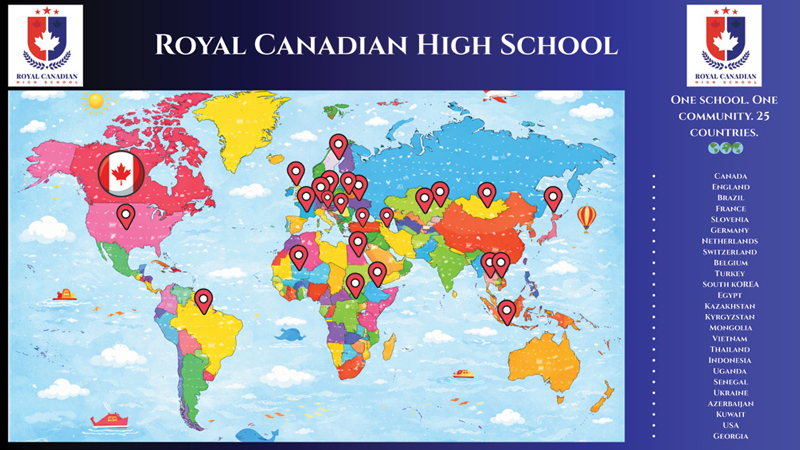
Delivered online but structured around consistent and intentional human engagement, the school establishes a shared academic culture that holds learning steady while respecting the contexts students bring with them.
Why does Royal Canadian High School emphasize consistent human engagement in its virtual learning model?
In doing so, RCHS functions as a deliberate bridge between education systems, cultures, and expectations, actively re-engineering stability and opportunity at moments when clarity and confidence are most at risk. That role shapes learning design by ensuring skills and assessments are consistent across systems.
“Learning isn’t built around one exam. We develop skills deliberately and assess progress over time through consistent academic practice,” says Kaeden Fletcher, academic coordinator.
What assessment philosophy guides Royal Canadian High School’s approach to evaluating student progress?
This reality is shaped by the challenges the school repeatedly encounters in its own classrooms. Many students arrive from systems where exam performance carries most of the weight, leaving skills like organization, inquiry, communication, and application underdeveloped. When these students enter an online environment, gaps surface quickly, especially where independent learning is assumed without shared structure. Movement between systems intensifies this pressure as expectations shift, while assessment practices focused on final outputs leave limited room for feedback, adjustment, or continuity.
-
Learning isn’t built around one exam. We develop skills deliberately and assess progress over time through consistent academic practice.
RCHS’s academic model is designed in direct response to these conditions.
How does Royal Canadian High School design assessment to support learning before, during, and after instruction?
Assessment tracks learning over time, before, during, and after instruction, rather than isolating performance in a single moment. Evaluation centers on coursework and engagement, with exams accounting for 30 percent and ongoing learning representing 70 percent. Grounded in Canadian and Ontario assessment principles, the model treats learning as cumulative, shaped through consistent effort rather than episodic testing.
At the center of RCHS’s approach is a deliberate focus on teaching students how to learn. This work is structured around four explicitly taught skills: organization, inquiry, communication, and application. Students are not expected to arrive already knowing how to direct learning.
The school builds knowledge, planning, and structure before progress is evaluated. From there, students develop inquiry and research skills by asking purposeful questions, selecting relevant information, and analyzing it for meaning rather than volume. Communication is treated as an academic skill, with students expected to express ideas using the language of each subject so that learning is internalized and transferable. The application requires students to apply knowledge in real-world contexts rather than limiting demonstrations of understanding to tests or written submissions.
Academic planning remains central to the school’s approach, supported by teachers, mentors, tutors, and educational planners. Each student begins with an individualized academic and career roadmap that is reviewed and adjusted over time to maintain alignment with future requirements. This continuity has supported placements at leading universities.
The impact of this model becomes clear through student experience. One student attending a physical school in Vietnam while studying simultaneously at RCHS described a noticeable shift in how he approached learning. Progress required sustained engagement, and assessments depended on genuine understanding rather than shortcuts or workarounds. Teachers acted as mentors, supporting the process without lowering standards. Over time, structure replaced uncertainty, and progress followed.
Looking ahead, RCHS is exploring ways to extend its work beyond high school and into postsecondary pathways. What remains constant is the school’s focus on continuity for students navigating global transitions. The school prioritizes learning structures that travel with students, ensuring progress does not reset each time systems, countries, or expectations change.

