


The school’s mission is to make a world-class education a joy-filled experience, and that principle helps explain why its students can take on demanding academic work without making pressure the center of school life.
The approach starts with a fairly practical question: why teach every child in exactly the same way when children do not learn in exactly the same way?
At Nysmith, that question has shaped the classroom model for years. Students move between subject-specific classrooms from kindergarten onward, allowing teachers to concentrate on the subjects they know best and enjoy teaching. A math teacher can focus on mathematics. A language arts teacher can focus on reading and writing. The classrooms themselves are organized around those subjects.
Teaching What Each Child Needs
Nysmith keeps class sizes small, with about 18 students and two teachers in each class. That gives teachers room to work with students in smaller groups and to adjust instruction when a child is ready to move ahead or needs more time.
A single class can contain several levels of instruction. In language arts, for instance, a young student might read well above grade level while developing writing skills at a different pace. In mathematics, only a few students may be working at a particular level. Instead of holding everyone to the same lesson, teachers can respond to those differences.
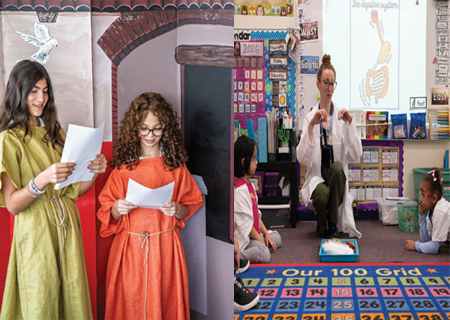 Kenneth Nysmith, Head of School says, “If you make it fun, you can teach children anything. But if you make it dry and boring, then you got to resort to pressure.”
That observation sits at the heart of Nysmith’s educational philosophy. The school does not see challenge and enjoyment as opposites. It believes students can work hard when they are interested in the work and when they do not feel that every mistake will be judged.
The same thinking applies to competition. Students take part in demanding academic contests and other activities, but the school tries to keep the result in perspective. A competition can be an opportunity to prepare, meet other students, test an idea, or simply experience something new. Winning is welcome, but it is not supposed to determine whether the experience was worthwhile.
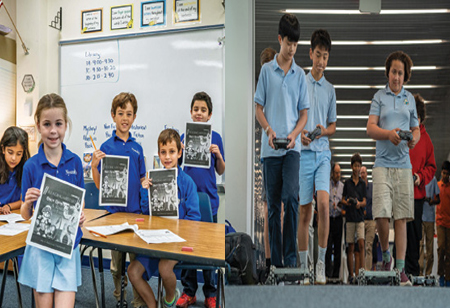 That distinction matters in a school where students regularly pursue ambitious goals. A child who is worried about coming in first may spend more energy worrying about the result than thinking about the task. Nysmith instead tries to give students enough confidence to take the risk of trying.
Building the Social Side of Learning
The school’s emphasis on individual growth does not mean learning is treated as a solitary activity. Beginning in kindergarten, students have a character education and communication class each week. The content develops as students grow older, moving from understanding feelings and other people’s perspectives to questions about relationships, communication, compromise, and happiness.
Much of that learning also happens in ordinary classroom moments. Children disagree. They say something they should not have said. They want a friend to do something their way. Rather than treating every conflict simply as a disciplinary problem, teachers can use those moments to talk about what happened and what each student could do differently.
-
Being able to use technology without being used by it, without just letting AI do the work for you, you know, being able to formulate the ideas and think and collaborate are so critical.
That approach carries directly into teamwork. Students involved in robotics, debate, Quiz Bowl, Science Olympiad, and other group activities need to explain their ideas, listen to other people, and accept that someone else may have a better approach. Those are skills that cannot be learned from a textbook alone.
Nysmith treats collaboration as a practical skill. Students learn how to make a case for an idea, how to hear another point of view, and how to find a solution that works for a group. The process can be messy, but that is part of the lesson.
A Small School, Many Directions
Nysmith has fewer than 200 middle school students, yet its students participate in activities that extend well beyond a conventional elementary and middle school curriculum. Mathematics and science sit alongside literature, history, music, entrepreneurship, robotics, programming, cybersecurity, and research.
The school attributes that breadth to noticing individual interests. Teachers can encourage a child’s interest in a subject rather than asking every student to follow the same path.
That has also shaped the school’s approach to academic competition. Nysmith students have taken part in major competitions and traveled for events, but Kenneth Nysmith recalls that some of the most memorable outcomes were not necessarily the trophies. Students could return from a major event excited about the people they met and what they experienced, even when they did not finish at the top.
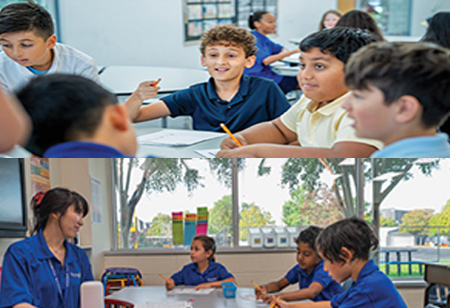 For a school focused on achievement, that is an important distinction. The objective is not to lower expectations. It is to remove the idea that a student’s value depends on meeting them perfectly.
The comment reflects another part of Nysmith’s work: helping students rediscover curiosity when previous experiences have made school feel like a place of pressure. The school believes a child who enjoys learning has a stronger foundation for taking on difficult material.
STEM Without Leaving Creativity Behind
Science and technology have been part of Nysmith’s identity from the beginning. The school was started 42 years ago by Kenneth Nysmith’s mother, while his father worked as a scientist for NASA. Science and technology were incorporated into the program early, and the school has continued to develop those areas as the fields themselves have changed.
Professional development is a major part of that effort. Teachers are expected to keep learning, and the school pays them for time spent on professional development. Science teachers explore new approaches to teaching science, while technology teachers stay current with tools and methods that can change rapidly.
If you make it fun, you can teach children anything. But if you make it dry and boring, then you got to resort to pressure.
The school has developed a strong reputation for STEM in the Washington metropolitan area, but it does not treat science and technology as more important than the humanities. History, language arts, literature, music, and creative work remain substantial parts of the program.
The connection between analytical thinking and creativity is especially visible in student projects. Nysmith has a logic class beginning in kindergarten that focuses on analytical and creative problem solving. Projects throughout the grades ask students to use their own interests and viewpoints.
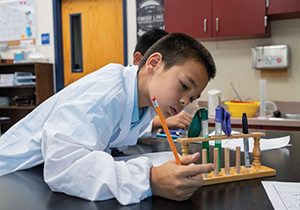
Even a science fair can become an exercise in imagination. Students are expected to engage seriously with the scientific question, but they are also encouraged to find an unusual or humorous way to present their ideas. The point is not simply to arrive at the expected answer. It is to ask what else can be done with the idea.
That same mindset shows up in the school’s approach to technology. VEX robotics has been part of the program, and flying drones are being introduced. The school keeps adjusting its curriculum as new tools become useful to students.
Learning to Live With AI
AI presents a more complicated challenge. Nysmith sees AI as an important part of the future but does not want students to use it as a substitute for thinking or writing.
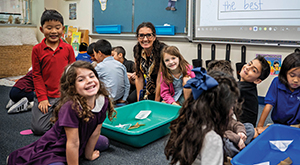 Because students do much of their writing in class, teachers can see how they develop their ideas. AI may be useful for illustrating or extending an idea, but the student still needs to understand the subject and do the intellectual work.
“Being able to use technology without being used by it, without just letting AI do the work for you, you know, being able to formulate the ideas and think and collaborate are so critical,” mentions Nysmith.
The school’s approach is likely to keep changing as the technology changes. That is already familiar territory for Nysmith teachers. Programs are adjusted continually, sometimes in small ways. A project used with one child may look noticeably different by the time a younger sibling reaches the same grade.
Those incremental changes add up. Teachers are not expected to reinvent the curriculum every year. They are expected to make it better.
Continuity with Room to Change
That willingness to adjust has been paired with unusual continuity in leadership. Nysmith is family-owned and operated and does not rely on fundraising as part of its operating model. Kenneth Nysmith has served as head of school for 17 years, and his son now works at the school.
For the school, that family connection provides a link to the original vision while allowing the program to develop. There is no need to replace the school’s identity every time leadership changes. Instead, the focus remains on the same basic question: what will best nurture children?
The answer is not treated as permanent. Nysmith continues to look at teaching methods, educational psychology, curriculum, technology, and creative approaches to instruction. The school’s teachers are given room to contribute to that process, which helps keep the classroom experience from becoming static.
 That may be the clearest way to understand Nysmith School. Its small size is not presented simply as a number. It gives teachers time to know students, adjust instruction, notice interests, and intervene when a child needs support. Its academic expectations are not separated from its social-emotional work. STEM does not crowd out literature or the arts. Competition does not have to come at the expense of enjoyment.
Nysmith School has been named Top Pre-K8 Grade School for 2027, adding a new point of recognition to a school that has spent decades developing its own approach to education. For Nysmith, however, the work appears far from finished. The next change may be a new technology, a different teaching method, or a small adjustment to a classroom project. The constant is the belief that children should be challenged, supported, and given reasons to enjoy the process of learning.

