


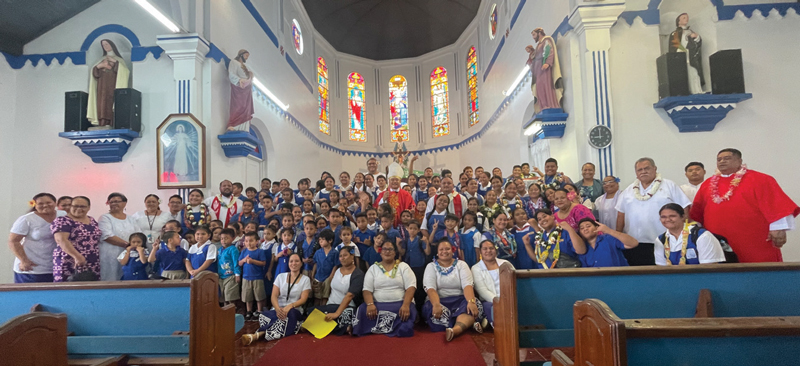
“It’s important for them to know who they are and what makes them different from the whole world, through our culture and language,” says Dr. Annie Fuavai, treasurer, Alao Parish.
This 119-year-old school exemplifies perseverance in a tight-knit community. When it nearly closed in 2017 due to financial issues, parish members united to keep it alive. Their solidarity and communal efforts made it possible for the school to have improved amenities, such as a gymnasium, cafeteria and covered walkways to protect children during rain.
Families, Culture and Faith in Action
Cultural resilience informs teaching methods. The school offers multi-dimensional Catholic education from preschool through grade eight, integrating faith, culture and academics. Children take part in innovative activities such as studying a Pacific island per class, allowing them to explore and share the regional way of life.
The school’s students also earn recognition beyond campus. NASA selected MSF-MMM’s ‘Doves of the Galaxy’ for the TechRise Student Challenge 2025 to 2026, placing the team among 60 winners who receive $1,500 to design and test an experiment on a NASA-sponsored flight.
-
It’s important for them to know who they are and what makes them different from the whole world, through our culture and language.
Faith is an integral part of the curriculum. Students take catechism class and group prayers. These catholic values are reflected in the way children behave toward each other, interact with adults and see their place in the world.
To reinforce those values at home, Marist St. Francis Elementary maintains consistent communication with parents, meeting them four times a year. The school’s parent-teacher association meets monthly to plan activities, graduations and champion student safety. Parents are informed about school events through the school’s website and Facebook page.
“We feel it's very important that we continue to provide updates. It's an opportunity for the parents to share any concerns or any suggestions they may have in improving the school,” says Fesoliai Sesilia Time, secretary, MSF PTA representative.
Marist St. Francis Elementary also offers an after-school program for students needing coursework help or supervision until their parents return from work. It also opened a daycare nearby for toddlers, catering all-around care and generating extra revenue to support its cause.
National Oceanic and Atmospheric Administration also selected Marist Saint Francis as an Ocean Guardian School for 2025 to 2026, linking student learning with conservation work tied to local watersheds and the ocean.
Resilience That Shapes Leaders
Everything at Marist St. Francis Elementary thrives on community support. The board provides financial updates and seeks parish feedback, while supporters donate money, time or talent. Teachers, volunteer priests and parish supporters handle both teaching and administration. Altogether, this dedicated group helps the school flourish.
Marist St. Francis Elementary is the only middle school in American Samoa with a Future Business Leader of America Middle School Chapter. It molds students into strong, kind adults who are proud of their heritage and learn how to respect different cultures. That foundation endures beyond graduation. Students often return to civic, church and professional roles in their community. Dr. Fuavai, for example, pursued advanced degrees after school and returned to support the mission. What began during a financial crisis is now a model for community-led education, showing that when a community unites, it builds something stronger.

