

University of Exeter
Navigating Higher Education in UK as a Black Woman and Providing Role Modelling to Black Students in High Schools Around Exeter Area
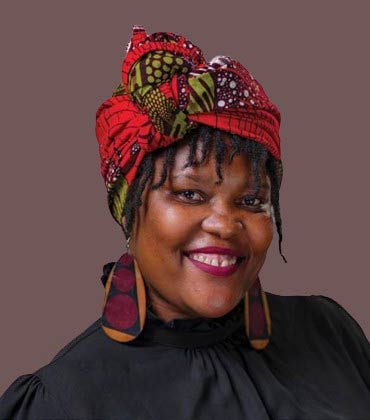
Melody Kuziwa Jombe
My journey in academia started a long time ago (more than 30 years). Born and bred in Zimbabwe, surrounded by numerous structural disadvantages, my journey is a story of hope and motivation for all black students, regardless of their heritage. Having grown up in Africa, it is to be expected that access to black role models would be an easy task. However, that was never the case.
After acquiring my first degree at the age of 34, I knew that the luxury of time would not be on my side if I were to live my dream of becoming a professor. Having no formal job at the time, being a single parent and a migrant, I was often faced with triple minority status. Thus, my career progression was always clouded with numerous challenges. I resorted to manual jobs for sustenance. I successfully finished my first and second degrees within a space of six years. 2019, I pursued an MPhil, and that is when the tides changed. I loved walking the corridors of the University of Pretoria with my backpack, imagining myself as a young girl who was finally at a traditional university. It was at that moment that I knew the onus was on me to make a difference to that girl who was about to lose hope. Fast forward to 2022, I moved to England for employment. Was I not excited, as this was a huge milestone for me and my children.
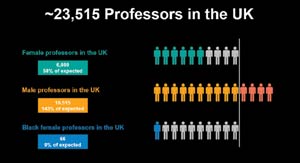
My journey in a Higher Education Institution (HEI) has had its own fair share of challenges, including a massive underrepresentation of black women professors in the UK. In 2023, out of 23,515 professors, only 66 were black women (see Fig 1) for the breakdown. These numbers are shocking and call for positive action throughout the academic pipeline.
"There is a dire need for a systemic change and to increase the number of black women represented at every stage of the academic pipeline"
There is a dire need for a systemic change and to increase the number of black women represented at every stage of the academic pipeline. Fortunately for me, when I joined Higher Education in the UK, my employer took part in an acceleration program of black women academics, “the 100 Black Women Professors Now Programme” (100 BWPNow), an initiative that is run by the Women in Higher Education Network (WHEN). The program aims to work together with multiple stakeholders, including institutional leaders, line managers, and academic cohort (black women tenured academics/Ph.D. students) to drive for a systemic change. Being part of the program exposed me to numerous opportunities, including having meaningful conversations with the Vice Chancellor and other Institutional leaders.
Figure 1: UK Professoriate data in 2023c
Rollock’s 2019 Staying in Power report highlighted the critical underrepresentation of black women in UK HEIs. The report highlighted deep-rooted institutional racism embedded in HEIs as a major roadblock for black women's academic progression. Additionally, there is a lot of gatekeeping of information when it comes to black women; thus, many of these academics are stagnant for years careerwise. This, combined with limited access to mentorship, career coaching or peer support networks, has acted as a barrier to black women progressing within academia. Having had the opportunity to be part of the program, my colleague and I decided to have a positive impact beyond the academic spheres on the black students around the Exeter area. Currently, we are working on a project with black students in high schools, offering them role modeling and mentorship programs. The aim of the project is to ensure that we motivate, bring hope, share our authentic stories, and bridge the current gap in the accessibility of black role models in HE. We believe stretching back to the grassroots level will have a long-term impact on improving the representation of black people in different institutions of learning

Get the best of Education Insider delivered directly to you.
