
The greatest personal finance disaster of the modern era is not merely inflation, debt, or rising housing costs. It is the quiet collapse of retirement security caused by the transfer of financial responsibility from institutions to individuals without a corresponding increase in financial education or preparation.
Personal finance curriculum has not kept up with this economic change.
The Twentieth Century Model
Retirement planning in the United States rested on three pillars: employer pensions, Social Security, and personal savings. Many workers could reasonably expect to retire with a guaranteed monthly income from a pension. High school consumer math reflected that reality. Students learned budgeting, debt management, and simple interest calculations because retirement itself was largely institutionally managed; employers carried investment risks and guaranteed retirement income.
That system no longer exists.
Today, pensions have been replaced by defined-contribution plans such as 401(k)s. Responsibility for retirement security shifted from institutions to individuals. Americans are now expected to manage complex decisions regarding savings rates, investments, market risks, retirement withdrawals, and portfolio sustainability—responsibilities once handled by pension managers. Millions of Americans were moved into a self-managed system they were never adequately trained to navigate. The result: a growing retirement readiness gap. Of those age 55-64, 43% have $0 retirement savings. Fifty-eight percent of retirees don’t know how long their retirement savings will last.
But the educational system failed to adjust.
Today, retirement security depends on an individual’s ability to manage financial resources through decades of financial complexity, yet consumer math programs remain largely oblivious to this new economic reality. Despite expanded financial education requirements, national surveys show that Gen Z scores the lowest of all age groups on measures of financial literacy.
Most programs continue to teach a common set of twentieth-century financial skills while giving comparatively little attention to the long-term financial planning responsibilities that now define adult financial life. Traditional programs often omit market returns, savings yields, and inflation rates—the very factors that drive long-term financial outcomes.
Students learn isolated financial skills such as:
• How to budget.
• Save for retirement.
• Invest early.
• Avoid debt.
• Live below your means
Students walk away with fragmented knowledge and limited understanding of how the components work together.
These programs often fail to ask the most important question: What is the ultimate goal of personal finance?
The ultimate goal of personal finance is not budgeting, investing, or even debt reduction. Those are tools.
The ultimate goal is lifetime financial security through retirement.
That goal needs to drive personal finance curriculum.
Financial Education for a Post-Pension World
Both consumer math programs and the broader culture place enormous emphasis on debt management—with popular budgeting apps, credit-score monitoring, and debt-reduction strategies. But they miss the ultimate goal. As retirement approaches, the burning question is not, “How much debt did I have?” but “Will my money last?” That is an asset-management question—the very question financial education should focus on.
The Wise Builder curriculum places that goal at the center of personal finance education.
At its core, financial security follows a simple progression: Income → Savings → Assets → Retirement Income → Lifetime Sustainability
Most curricula stop at assets. Students are taught how to save and invest, but rarely what sustainable retirement income requires.
In The Wise Builder, achieving lifetime financial security becomes the organizing framework for the entire course. This financial planning model shows how savings rates, investment returns, inflation, and Social Security benefits work together to determine retirement-income sustainability.
The Lifetime Income graph distills the complexity of long-term financial planning into one simple picture: Here’s what happens to your lifetime income based on your choices.
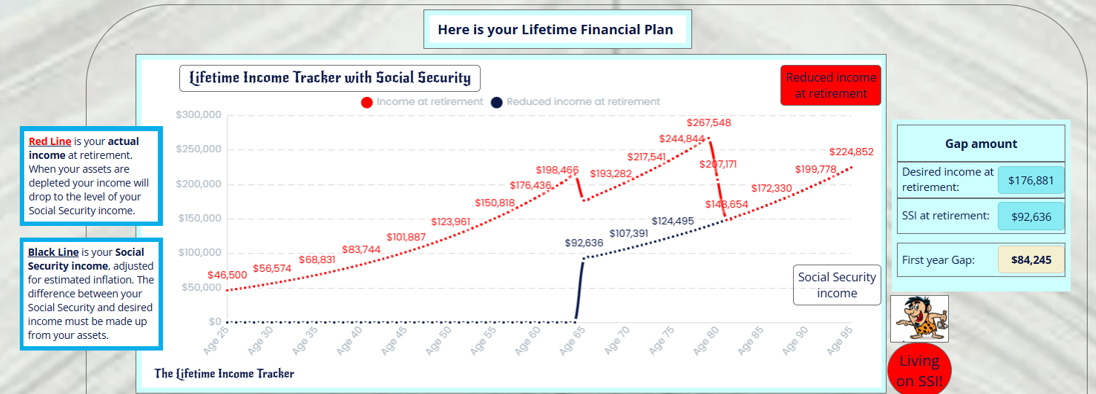
Consumer math asks students to solve equations: save $X and earn Y% to accumulate $Z. The Wise Builder asks students to solve the financial challenge every adult faces: How much is needed for lifetime financial security.
Instead of simply being told “save for retirement,” students learn how much saving may be required to achieve specific retirement-income targets. Students can adjust the variables:
• What happens if I save 15% instead of 10%?
• What happens if I retire three years earlier?
• What happens if inflation rises?
Now students are taught to think like financial planners, not just savers, and answer the question millions of adults actually worry about: Will my money last?
Lifetime Financial Planning Begins with the First Paycheck
Recent legislation recognizes this. Employers are now required to automatically enroll new employees in their 401(k) plans. If employees do not make selections, employers are required to choose default contribution rates and investment options for them. This means young adults will face retirement decisions as soon as they enter the workforce—or those decisions will be made by others. They need to understand their choices, especially if their employer does not offer a retirement plan. Their decisions today will compound for decades.
The Role of School
This new era requires a fundamental change in personal finance curriculum.
Since young adults are expected to function as their own financial planners, schools must begin teaching them how to think like financial planners. If students do not learn this in high school or college, when will they learn it?
What if your students entered adulthood with a clear financial plan—before credit cards, loans, and social media shaped their financial choices?
You only get one chance to prepare for retirement. That opportunity begins with education. We can make a dent in the retirement crisis for the next generation.
The Wise Builder was designed to do that.
For direct inquiries to implement The Wise Builder in your high school or college: Dana@TheWiseBuilder.org
www.thewisebuilder.org
Personal finance curriculum has not kept up with this economic change.
The Twentieth Century Model
Retirement planning in the United States rested on three pillars: employer pensions, Social Security, and personal savings. Many workers could reasonably expect to retire with a guaranteed monthly income from a pension. High school consumer math reflected that reality. Students learned budgeting, debt management, and simple interest calculations because retirement itself was largely institutionally managed; employers carried investment risks and guaranteed retirement income.
That system no longer exists.
Today, pensions have been replaced by defined-contribution plans such as 401(k)s. Responsibility for retirement security shifted from institutions to individuals. Americans are now expected to manage complex decisions regarding savings rates, investments, market risks, retirement withdrawals, and portfolio sustainability—responsibilities once handled by pension managers. Millions of Americans were moved into a self-managed system they were never adequately trained to navigate. The result: a growing retirement readiness gap. Of those age 55-64, 43% have $0 retirement savings. Fifty-eight percent of retirees don’t know how long their retirement savings will last.
But the educational system failed to adjust.
Today, retirement security depends on an individual’s ability to manage financial resources through decades of financial complexity, yet consumer math programs remain largely oblivious to this new economic reality. Despite expanded financial education requirements, national surveys show that Gen Z scores the lowest of all age groups on measures of financial literacy.
Most programs continue to teach a common set of twentieth-century financial skills while giving comparatively little attention to the long-term financial planning responsibilities that now define adult financial life. Traditional programs often omit market returns, savings yields, and inflation rates—the very factors that drive long-term financial outcomes.
Students learn isolated financial skills such as:
• How to budget.
• Save for retirement.
• Invest early.
• Avoid debt.
• Live below your means
Students walk away with fragmented knowledge and limited understanding of how the components work together.
These programs often fail to ask the most important question: What is the ultimate goal of personal finance?
The ultimate goal of personal finance is not budgeting, investing, or even debt reduction. Those are tools.
The ultimate goal is lifetime financial security through retirement.
That goal needs to drive personal finance curriculum.
Financial Education for a Post-Pension World
Both consumer math programs and the broader culture place enormous emphasis on debt management—with popular budgeting apps, credit-score monitoring, and debt-reduction strategies. But they miss the ultimate goal. As retirement approaches, the burning question is not, “How much debt did I have?” but “Will my money last?” That is an asset-management question—the very question financial education should focus on.
-
Since young adults are expected to function as their own financial planners, schools must begin teaching them how to think like financial planners.
The Wise Builder curriculum places that goal at the center of personal finance education.
At its core, financial security follows a simple progression: Income → Savings → Assets → Retirement Income → Lifetime Sustainability
Most curricula stop at assets. Students are taught how to save and invest, but rarely what sustainable retirement income requires.
In The Wise Builder, achieving lifetime financial security becomes the organizing framework for the entire course. This financial planning model shows how savings rates, investment returns, inflation, and Social Security benefits work together to determine retirement-income sustainability.
The Lifetime Income graph distills the complexity of long-term financial planning into one simple picture: Here’s what happens to your lifetime income based on your choices.
Consumer math asks students to solve equations: save $X and earn Y% to accumulate $Z. The Wise Builder asks students to solve the financial challenge every adult faces: How much is needed for lifetime financial security.
Instead of simply being told “save for retirement,” students learn how much saving may be required to achieve specific retirement-income targets. Students can adjust the variables:
• What happens if I save 15% instead of 10%?
• What happens if I retire three years earlier?
• What happens if inflation rises?
Now students are taught to think like financial planners, not just savers, and answer the question millions of adults actually worry about: Will my money last?
Lifetime Financial Planning Begins with the First Paycheck
Recent legislation recognizes this. Employers are now required to automatically enroll new employees in their 401(k) plans. If employees do not make selections, employers are required to choose default contribution rates and investment options for them. This means young adults will face retirement decisions as soon as they enter the workforce—or those decisions will be made by others. They need to understand their choices, especially if their employer does not offer a retirement plan. Their decisions today will compound for decades.
The Role of School
This new era requires a fundamental change in personal finance curriculum.
Since young adults are expected to function as their own financial planners, schools must begin teaching them how to think like financial planners. If students do not learn this in high school or college, when will they learn it?
What if your students entered adulthood with a clear financial plan—before credit cards, loans, and social media shaped their financial choices?
You only get one chance to prepare for retirement. That opportunity begins with education. We can make a dent in the retirement crisis for the next generation.
The Wise Builder was designed to do that.
For direct inquiries to implement The Wise Builder in your high school or college: Dana@TheWiseBuilder.org
www.thewisebuilder.org


