

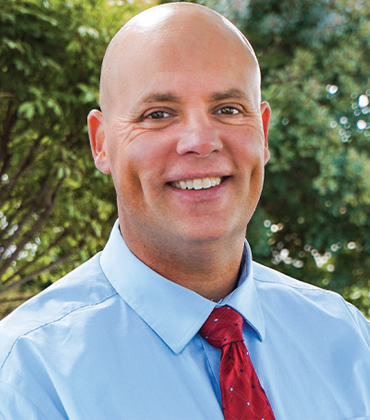
 Dave Harper, Principal
At FreedomProject Academy (FPA), this verse from Proverbs 22:6 is the lens through which the school thinks about learning, childhood and responsibility. The belief is that teaching a child to see the world through God’s truth and to think rather than just memorize shapes the choices they make long after the lessons end.
What educational philosophy guides FreedomProject Academy’s approach to learning, responsibility and faith formation?
FPA is a fully accredited, online, private school that offers a Judeo-Christian classical education from pre-K through high school. Teachers pay close attention to how individual students think, respond and grow. They guide each child in ways that fit their God-given strengths.
Because Scripture anchors the school’s worldview, subjects such as history, literature, science and mathematics are woven together to show students the world God created. This helps them study the ideas that shaped Western civilization and test arguments against both evidence and biblical views. The goal is to train students to recognize what is sound and to question what is not.
“We want our students to grow into young adults who can reason well, discern wisely and stand firm in truth,” says Principal Dave Harper. “Academic success matters, but the shaping of character is our greater responsibility. The classical model gives us a way to pursue both with intention and humility.”
That clarity of purpose is what led to FPA’s honor as the Christian School of the Year 2026—a recognition rooted in its unwavering commitment to guiding students to live what they learn.
How does FreedomProject Academy apply the classical Trivium to develop reasoning and communication skills?
The Trivium: A Pathway to Form Minds with Biblical Clarity
FPA’s classical education follows the Trivium, a framework that divides learning into three distinct stages. Grammar builds foundations, logic develops reasoning and rhetoric sharpens clear expression. Students at each stage learn how to think rather than what to think, a motto strongly upheld by FPA.
Early elementary students master the vocabulary and rules that anchor their learning. In junior high, the logic stage teaches them to question assumptions, test ideas and form their own judgments. They want to know why things work and that curiosity is fulfilled. In the upper grades, the rhetoric stage trains them to draw conclusions and express ideas in writing and speech. Students learn classical tools like schemes, tropes, ethos, pathos and logos that make communication clear and persuasive.
-
We want our students to grow into young adults who can reason well, discern wisely and stand firm in truth. Academic success matters, but the shaping of character is our greater responsibility. The classical model gives us a way to pursue both with intention and humility.
The Trivium framework gains depth through FPA’s curriculum, providing students with broader opportunities to apply what they have learned. Core subjects form the base while Latin strengthens language skills and helps students interpret modern vocabulary. Electives in economics, music theory, health, physical education and forensic science require students to apply reasoning in varied contexts. Formal logic and rhetoric courses sharpen their ability to write, speak and think clearly.
What role does FreedomProject Academy’s biblical worldview play in shaping curriculum and character development?
The technique produces clever speakers, but not always wise ones. Teachers weave Scripture through this structure to deepen understanding and character. In literature classes, whether reading works like Tom Sawyer, The Call of the Wild, Shakespeare or classical Western texts, students examine motives, virtues and struggles through a biblical lens. They learn what righteousness means as Scripture defines it. Discussions include how those principles shape daily choices. Academic work becomes a practice of wisdom.
This reflects FPA’s conviction that knowledge without God gives an incomplete view of the world. A Christian worldview helps students confront moral relativism, secular humanism and cultural pressure. Students who read the world through Scripture can approach ethical questions in science, evaluate arguments in history and understand purpose in civics.
“The pairing of rhetorical training with biblical conviction gives students the confidence to model Christlike character while speaking with depth and precision,” says Harper.
For him, this development reflects the union of faith and reason in the pursuit of truth. FPA’s classrooms stand in that tradition, helping students recognize moral clarity and consider what it asks of them.
Results are evident in both character and performance. Approximately 80 percent of graduates attend a two- or four-year college, with many receiving scholarships. Juniors and seniors often score at or above the 75th percentile on the SAT and ACT.
How does FreedomProject Academy support diverse learners through its online instructional model?
A School Without Walls, but Never Without Support
Operating online provides students with opportunities that are harder to access in traditional settings. Microphones, chat tools, polls and shared screens let them show their thinking in varied ways. Teachers see responses immediately and keep students engaged across learning habits. Every student is noticed and supported.
One young woman, bedridden and unable to speak, completed the most rigorous math and science track through an assistive device and graduated with honors. A blind student utilized adapted lesson formats, participated in live classes and demonstrated mastery through accommodations that leveled the playing field.
Parents are thrilled with their children’s success. One mother praised the math program’s requirement of 30 problems a day, four days a week, saying that the workload felt heavy at first, but the benefits became clear when her children began studying college-level math. Recorded lessons provide parents with insight into their child’s learning and help reinforce good habits and accountability.
This collaboration strengthens a central conviction for Harper. Parents are partners, not bystanders. Parents are seen as a child’s first teacher and that influence is expected to continue, especially in the early years when students need help pacing assignments and forming good habits. Pairing each household with an advisor allows parents to feel equipped, not overwhelmed.
Where Integrity Isn’t Taught, but Lived
FPA’s conviction that learning has meaning only when pursued with honesty built into its operations.
Students complete an academic integrity course that covers plagiarism, proper use of sources, citation practices and the limits of AI. If a student misuses sources or submits AI-generated work, consequences range from failure of the assignment to failure of the course. The aim is not punishment, but to help students understand that integrity is part of who they are.
Faculty adhere to that same standard. FPA looks for instructors whose lives reflect academic integrity, Christian virtue and a commitment to forming character as well as intellect. When students see their teachers uphold the principles they’re being taught, the lessons take root. The school’s culture endures because integrity is practiced, not just preached.
What Lies Ahead
FPA now partners with churches and brick-and-mortar schools that want to offer courses they cannot provide on their own. Logic, Latin and economics are examples of classes that fill gaps in local programs and extend FPA’s reach into Christian communities that share its vision. New co-curricular options, including a Mandarin Chinese club, will be introduced next spring, providing students with additional opportunities to explore their interests.
The Anytime Academy expands flexibility by recording live courses as asynchronous classes that students or adults can access at any time. Partner schools or churches can utilize these classes at their convenience and learners can submit assignments when ready, still receiving graded feedback from certified instructors.
Over the next five years, FPA will redevelop these Anytime Academy courses using a new studio recording platform, Riverside, to strengthen the quality and consistency of lesson production. The school is also preparing a series of short homeschool courses for families who want supplemental material outside the standard year-long format.
Further ahead sits the goal of launching an FPA university, offering degree programs in education, philosophy, history, political science and the humanities. The vision stays clear. FPA will continue to shape a curriculum that combines academic depth with a biblical perspective, so students are prepared for the lives they are called to lead.
A path formed as they learn to think clearly, act with conviction and step into their calling.

