


Would greater ownership change how students engage with learning?
The public charter school built its model around that premise, allowing students to choose how they approach required standards while maintaining clear academic expectations.
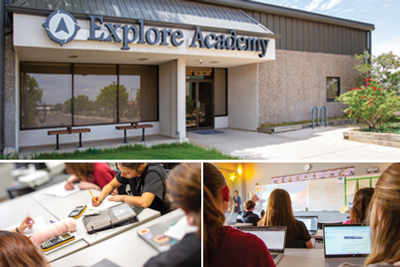 The idea took shape in the classroom, where Explore Academy’s founder, a former science teacher, noticed that students were more willing to take risks in elective classes because they had chosen them. He began wondering what might happen if every class offered the same opportunity.
“The teacher’s job isn’t to answer them, it’s to guide them to discovering their own answers,” says Jake Kolander, Head Administrator.
Choice Runs Through the Curriculum
A ninth grader at Explore Academy does not sign up for English 9 and stay there for the year. The school breaks standards into smaller units and lets students choose a thematic “flavor” for each course. Courses run in 20-day terms, with students taking five courses at a time across English, math, science, social studies and an elective. Over roughly 8 terms each year, students can take up to 40 uniquely flavored courses.
The approach changes the classroom dynamic. Students ask questions, participate in seminar discussions and work toward their own conclusions. Teachers guide those conversations and help students work through the material.
The academic expectations remain firm. Each course concludes with an exam and a project designed to assess mastery of its standards. High school students must meet an 80 percent mastery threshold, while the threshold is 70 percent in middle school.
Explore Academy uses a mastery-based approach in which students have opportunities to demonstrate understanding again as they progress. Later demonstrations of mastery can replace earlier results, allowing the final grade to reflect what a student knows by the end of the learning process.
By high school, students are making decisions that resemble those they will face in college. Starting in 10th grade, they can pursue majors such as law, medicine or creative writing. They must consider prerequisites, plan course sequences and manage their schedules.
-
The teacher’s job isn’t to answer them, it’s to guide them to discovering their own answers.
Explore Horizons extends that experience beyond the traditional school day. Students can earn credit through internships, travel and college courses. One student worried about missing school during a month-long trip to Papua New Guinea. Explore Academy instead developed coursework around the trip, allowing the experience to contribute toward high school credit.
Another student drew on the same flexibility during COVID to take four AP exams. Teachers provided individualized coaching and resources. She completed all four tests and earned a five on each.
The University of New Mexico has offered another perspective on the model. Several recent graduates told Explore Academy that university orientation felt familiar because they were already accustomed to selecting pathways, managing schedules and working within a more open academic environment.
The school also learned that students could enter high school with learning gaps that began much earlier. Explore Academy initially served grades 9 through 12 before adding middle school and, after identifying gaps among incoming students, eventually K-5.
Elementary students now have opportunities to make choices as well, while foundational skills remain central. The school uses objectives and key results as a school-wide goal-setting practice, including an objective focused on helping students reach grade-level reading proficiency before they leave fifth grade.
Building Independence with the Right Support
Teachers carry much of the responsibility for making the approach work. They review student data through professional learning communities, adjust instruction and work closely with students in classes generally limited to 18 to 20.
The model also supports diverse learners through an inclusion approach, with special-education students and English language learners learning alongside the general-education population while receiving additional support and scaffolding where needed.
The school is also taking a deliberate approach to AI. Its guidelines allow teachers and students to use AI where it supports the learning process while limiting unrestricted use and keeping critical thinking at the center.
A highly involved teaching model supports student independence. For Explore Academy, the value of choice lies in what students learn to do with it. They learn to weigh options, respond to setbacks and take responsibility for the direction of their education. It is this emphasis on student agency and responsibility that underpins Explore Academy’s recognition as the Top Public Charter School 2026.

