


A strong connection between teachers and students shapes how learning happens at Explorations Charter School. With only 92 students across grades nine through twelve, the school is intentionally small, allowing teachers the time to truly know each student and build lasting relationships.
Rather than focusing only on performance, teachers pay close attention to where each student is in their learning and what will help them move forward. Small classes, often around ten students, allow teachers to notice when someone needs help and respond quickly. Students frequently say they understand concepts more clearly because teachers have the time to work with them individually.
“The goal is not just to look at how a student is performing, but to pay attention to what they need to take the next step and help them get there,” says Jill Johnson, executive director and principal.
Challenge by Choice
How does the challenge by choice model influence student participation and personal development?
Students are asked to challenge themselves through choice, deciding what participation looks like based on their comfort level with guidance from teachers and support from peers. The school’s Adventure Education program provides that setting one day each week through activities such as hiking, biking, kayaking, rock climbing, snowshoeing, ice skating and cross-country skiing.
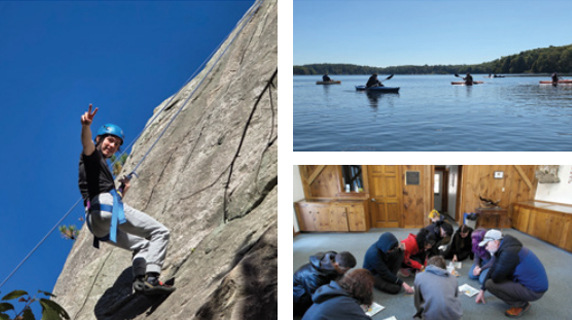 The principle of “challenge by choice” lets students set their own goals rather than being told what they must do. They may decide how high to climb, how far to hike or how many miles to ride.
A student who does not feel comfortable climbing a rock wall, for example, might help teammates with their harnesses, carry ropes or cheer others on. As confidence grows, many choose to push themselves further.
Activities often involve teamwork. During the school’s planned mini-Olympics, teams of one teacher and five students were to design and build bobsleds using plastic bags, cardboard and duct tape before racing them down a hill, requiring creativity, planning and collaboration.
Experiences like these allow teachers and students to interact outside the classroom, strengthening the relationships that support learning.
Learning Guided by Student Interests
Why does Explorations Charter School develop courses based on student interests and emerging learning needs?
Alongside core subjects such as English, math, science and history, the school often develops courses based on conversations with students about what they want to learn next.
-
The goal is not just to look at how a student is performing, but to pay attention to what they need to take the next step and help them get there.
Interest in art recently led to the introduction of a college-level Color Theory course taught by an educator who holds a master’s degree in art and also teaches at the college level. When students completed that course and asked for more, the school introduced a Tactile Arts class where they apply what they learned through sculpture, sewing and design projects. Student interest also led to the introduction of coding and computer science classes taught by a mathematics teacher. For more specialized topics, the school offers independent study opportunities in which students pursue self-directed learning under the guidance of a teacher mentor.
Teachers at Explorations often take on multiple roles throughout the school day. The school’s 11 certified staff members lead classes, coordinate internships with local businesses and run after-school activities. Through these experiences, students interact with teachers in many different settings, building connections that extend beyond the classroom.
Widening Pathways for Students
To what extent does Explorations expand opportunities through career pathways and individualized student support programs?
Explorations is a ‘school of choice’ in Connecticut, meaning students who were often overlooked and disengaged in larger settings found a place to reset, rebuild confidence and thrive again. Sustaining that support, the school focuses less on expanding enrollment and more on creating opportunities for the students it serves.
Through the College and Career Accelerator program offered by EdAdvance, students can leave campus during the school day to pursue pathways such as pre-engineering and CAD design, with medical and public safety programs expected to follow. Participation has grown from seven students last year to twelve this year.
One graduate from the class of 2023 is completing college a full year early after earning credits while attending Explorations.
Education Insider’s recognition as Top Charter School 2026 reflects the school’s continued focus on building relationships and opportunities that support students to grow into who they want to become with clear direction and purpose.

