

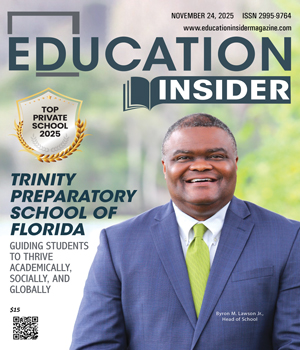
What if students aren’t given the guidance, support, or opportunities they need to reach their full potential? Without strong leadership, schools can struggle to inspire growth, nurture talent, or prepare students for the challenges of the real world. Academic excellence alone isn’t enough; students need mentors, vision and a community that encourages them to explore, learn and thrive. This is where inspiring educational leaders make a difference. They create environments that foster curiosity, resilience, and ethical decision-making. By guiding students academically, socially, and personally, they transform schools into communities where every learner feels supported, challenged and empowered to succeed not just in school, but in life. Byron M. Lawson Jr., head of school, guides Trinity Preparatory School of Florida by combining academic vision with operational and financial leadership. He focuses on a comprehensive learning experience that enables students to grow academically, socially, and personally, while fostering character, resilience, global awareness, and ethical leadership. Key Milestones and Achievements Under His leadership include: ● Updating the mission served to redirect the energies of the Shaping the Trinity Experience includes: entire institution. ● 519 students currently sit for more than 1,100 AP exams, reflecting rigor and opportunity. ● Establishment of a state-of-the-art Nochur Sankar Science Centre with a BSL-2 lab, offering hands-on research experiences typically reserved for professionals. ● Global collaborations with schools in South Africa, Australia, Israel, China, France, Peru, and Brazil. ● Graduates are achieving success in top universities worldwide and leadership roles in medicine, research, and entrepreneurship. ● Building a 30,000 square foot Science Center, one of its kind in Central Florida. Under his leadership, Trinity Prep has launched initiatives such as an immersive Interim Term, global partnerships and flexible learning pathways to ensure students are prepared for a dynamic, interconnected world. The school has also updated its mission and comprehensively reviewed all school operations to enhance wellness for the learning community.
Top Charter School 2025
How Sequoia Grove Charter Alliance is Redefining What School Can Be What if learning didn’t begin and end with the school bell, but instead took shape all day long at kitchen tables, in art studios, on hiking trails, and across virtual classrooms—places where curiosity has room to grow and students of all ages take ownership of their education? At Sequoia Grove Charter Alliance, a network of three public charter schools across Northern California—Clarksville, Feather River, and Lake View—this vision comes to life each day. Grounded in a shared belief that learning should be flexible and deeply personal, students here are active participants in shaping their own academic journeys. Homeschool teachers (HSTs) are the heart behind this innovative model. As credentialed teachers, they provide expert guidance to parents or learning coaches who are responsible for facilitating daily instruction. It’s a collaborative method that ensures students are making academic progress while adapting to their unique learning styles. Relationships reinforce the model as students are assigned to a teacher as a family unit. Teachers often remain with families for years. This approach creates continuity, stability, and a sense of ownership that many families feel is missing from more traditional settings.
Top Classroom Furniture Provider 2025

VS America builds on a legacy of over 127 years of excellence in educational furniture. Its adaptable, ergonomic furniture for K–12 schools, colleges and libraries fosters movement, collaboration and engagement, creating learning environments that grow alongside their users. Founded in Tauberbischofsheim, Germany, its parent company, VS has grown into a leading provider of educational furniture. VS America was founded in the early 2000s and serves schools across the Americas from its headquarters in Charlotte, North Carolina. A robust stocking program and warehouses in Charlotte, Houston and Nashville, Illinois ensure the timely delivery of high-quality learning furniture. “To create spaces that truly support education, we consider how every element affects students’ health, engagement and learning outcomes,” says Karina Kentsis, regional sales director. The principle stems from VS’s decades of research and partnerships, including a historic collaboration with renowned Italian physician and educator Maria Montessori. VS translated her philosophy of self-directed learning into practical solutions for classrooms, with user-centered design and pedagogy-driven furniture. A Heritage of Classroom Innovation VS has exclusively focused on educational spaces throughout its history. In the late 1800s, hygiene was paramount because of the many infectious diseases at the time. The Rettig bench, designed by architect Wilhelm Rettig, addressed these challenges with a bench design that could be turned on its side, allowing classrooms to be cleaned easily and thoroughly. Over time, these ideas evolved into flip-and-stack tables and chairs that suspend from desktops. The change transformed traditional classrooms into environments that are suited for both collaboration and quiet study.
Private Schools

Navigating the Evolving Landscape of Education
Dr. Nadirah Nayo, Director of Curriculum and Instruction, Pasadena Unified School District
Private Schools

Building an Inclusive and Innovative Tech Ecosystem
Julian Erber, Director of Technology and Innovation, Parkway Schools
Private Schools

Why the Best Leaders Consider Every Variable
J. Brock Tarno, Director of Special Education, Georgia Cyber Academy
Private Schools

Transforming Education through Technology Leadership
Hector Hernandez, Director of Technology Operations, Aspire Public Schools
Private Schools

Harnessing Neuroplasticity: The Role of Social-Emotional Learning in Classroom Success
Joy Davis, Director of Special Education, Twin Rivers Unified School District

IN MY OPINION
Private Schools
Transitioning to Remote Learning Efficiently
Neal C. Weaver, Ph.D., CETL, Deputy Superintendent of Operations, Santa Fe Public Schools

LAST WORD
Private Schools
Flipping the K-12 Educational Technology Script: How will we respond?
Kourtney Bostain, Director of Innovation, Henrico County Public Schools
IN FOCUS

Charter Networks as Catalysts for Systemic Change
Charter networks are transforming the edtech marketplace by centralizing procurement, demanding integrated solutions, prioritizing data-driven efficacy, and fostering collaborative partnerships with vendors.

Student Agency as the Cornerstone of Modern Private Schooling
Student voice and agency are transforming private education, promoting self-direction, involvement in governance, personalized learning, and essential skills for lifelong success and citizenship.
EDITORIAL
Educating for Depth, Not Just Direction
This edition features Trinity Preparatory School of Florida, recognized as the Top Private School. Under the leadership of Head of School Byron M. Lawson Jr., Trinity Prep demonstrates what education can look like when intellectual rigor meets character development. The school combines academic excellence with personal growth, empowering students to lead with purpose. Initiatives like global partnerships, immersive learning pathways and its Interim Term reflect an understanding that knowledge alone is incomplete without adaptability and awareness. Every program, from advanced science labs to service collaborations with Habitat for Humanity, reminds students that leadership begins with empathy and that every classroom should foster a sense of community.
Technology’s role within this transformation cannot be overstated. Educators are navigating a delicate balance between innovation and human connection, ensuring that digital tools enhance, not replace, meaningful interaction.
This balance is where leaders like Julian Erber, Director of Technology and Innovation at Parkway Schools, and Hector Hernandez, Director of Technology Operations at Aspire Public Schools, are shaping the conversation. Their experiences highlight how thoughtful technology integration strengthens instruction, creates agile systems and builds classrooms that adapt to both student and teacher needs.
The next phase of education will belong to schools that pair innovation with intention. When institutions cultivate intellect and character equally, learning stops being a transaction and becomes a lifelong transformation.

