

Rosemary M. Thomas
Preparing Students for Life, Not Just Careers
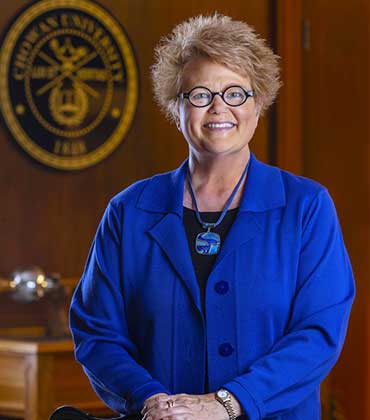
Rosemary M. Thomas is an American academic leader and the 24th president of Chowan University. Appointed in 2024, she became the institution’s first female president. With a background in educational leadership and public administration, she has held senior administrative roles at several U.S. universities and is recognized for strengthening student success, fundraising initiatives and institutional growth.
Leading with Faith, Family and Future
My leadership is grounded in three words: faith, family and future. As a Christian institution, faith begins with our belief in Jesus Christ, and extends to the faith we place in our students, in their potential and in our responsibility to prepare them for lives of purpose. At the same time, we do not impose religious participation. We welcome students from all backgrounds and belief systems, while continuing to lead from a Christian foundation. Our responsibility is not to tell students what to think, but to teach them how to think.
Family reflects the environment we create on campus. Our student body spans more than 40 countries, with some students arriving independently and others supported by strong family networks. In both cases, our role is to create a sense of belonging, giving students the confidence to take risks, to grow and to step into unfamiliar environments.
If we get faith and family right, the future will take care of itself. That future is built on quality academics, meaningful internships and practical experiences, alongside a commitment to developing individuals who think, collaborate and remain coachable through life. They should grow intellectually, professionally, spiritually and personally.
Success Through Mission Alignment
Institutional success is not defined by scale alone. It is defined by how closely we align with our mission and how well we support our people. Operating within enrollment pressures and financial constraints has reinforced the need to expand resources by improving operational efficiency and developing new revenue streams.
Right-sizing the institution rather than upsizing ensures stability and long-term strength. A smaller institution that remains true to its purpose is often more effective than one that grows without direction.
Success is retention, course completion and postgraduate outcomes and the health of the campus community. A strong culture is one where individuals feel known, valued and connected, and relationships between students and faculty are meaningful. Ultimately, we trust the long-term impact of this work, knowing that it shapes not just current students but generations to come.
Reimagining Academic Delivery
One of the most significant shifts at Chowan has been the redesign of our academic delivery model. Students now take two courses at a time over seven-week terms, attending classes four days per week, with a mid-cycle break before repeating the structure.
This reflects the needs of post-pandemic learners who benefit from focused attention, structured pacing and continuous engagement. From the outset, attendance, participation, and assignment completion are non-negotiable.
The impact has been measurable. Academic performance has improved, and mastery of learning outcomes has strengthened. We have also shifted how outcomes are evaluated. Rather than relying on end-of-term assessments, we focus on realtime performance. Faculty play a central role in this process, providing daily qualitative feedback that helps students refine their understanding and prepare for future learning.
This model benefits faculty as well. It allows them to better understand individual learning styles and provide personalized mentorship for broader academic and professional development.
“A smaller institution that remains true to its purpose is often more effective than one that grows without direction.”
Strengthening Student Success
Student success at Chowan is built through a coordinated and intentional support system that integrates academic, personal and professional development.
I often describe retention as a three-legged stool. Each student is supported by an admissions counselor, an academic advisor and a third point of engagement. For many students, that third connection is a coach, given the strong presence of student-athletes on campus. For others, it may be involvement in Christian life, cultural programs, Greek life or other campus activities.
Academically, we provide both challenge and support, preparing students for the demands of professional life. Professionally, we emphasize early and continuous exposure to internships, job fairs, resume development, professional etiquette, and real-world expectations. Financial literacy, social media awareness, and career readiness are embedded into the student experience. Personally, development occurs through athletics, mentorship, or community engagement. Students build confidence, communication skills and the ability to contribute meaningfully to society. The concept of coachability is central here. It is not limited to athletics but extends to the classroom and to life, shaping how students respond to feedback, adapt and grow.
Recruitment also plays a critical role. We ensure students who choose Chowan understand and value the experience of a small, private, residential, Christian, liberal arts institution. The first-year experience has been strengthened to provide a more effective onboarding process.
Aligning Operations, Enrollment and Institutional Accountability
As President, I am responsible for leading and managing all aspects of the University while protecting its mission and brand. This includes accountability to the Board of Trustees, faculty, staff and students.
One of my early priorities was restructuring enrollment management to bring together admissions, financial aid and retention. This integration has created a more intentional student success model that connects academic affairs, student life, residence life and career services.
Breaking down silos, particularly between athletics and the broader campus, has been key. Greater collaboration has strengthened operations and the student experience. Recruitment and retention are now shared priorities across the institution.
We are keenly focused on alumni engagement and private fundraising to reduce reliance on tuition revenue. We are exploring ways to better utilize campus and regional assets while forming partnerships that support institutional growth.
Technology has played a supporting role in improving efficiency and data-driven decision-making. Changes we make are intended to be beneficial for all stakeholders, and we remain prepared to assess and adjust if they do not deliver the expected outcomes.
Partnerships are central to expanding opportunities for students and strengthening the institution. For example, long-standing community engagements such as Relay For Life provide ongoing opportunities for student involvement and connection. Similarly, partnerships in the performing arts have allowed us to reintroduce meaningful cultural experiences into the curriculum.
Leading Through Trade-offs, Data and Institutional Responsibility
The presidency requires a shift from advocating for a single department to serving the entire institution. Every decision involves balancing mission and margin, short-term stability and long-term positioning.
Structural progress is defined by durability and repeatability. True progress extends across departments, builds momentum and reduces institutional vulnerability.
An example of this is the development of graduate programs following the pandemic. While initially expected to be a short-term opportunity, these programs have demonstrated sustained growth and have become an integral part of strengthening the institution’s future.
“Changes we make are intended to be beneficial for all stakeholders, and we remain prepared to assess and adjust if they do not deliver the expected outcomes.”
Strengthening Culture Through Team Building
A strong institution depends on a strong and empowered team. We are a teaching-focused, outcomes-driven institution, and the dedication of our faculty has been instrumental in implementing major changes, including the academic model transformation. Supportive faculty and staff create alignment through consistent communication.
Team building also requires diversity of thought. Bringing together individuals with different perspectives and skill sets allows us to make more informed decisions and move forward with greater clarity.
Looking back, one area I would refine further is communication. While urgency required rapid decision-making, there were opportunities to communicate earlier, more frequently, and with clearer sequencing. Explaining not only intended outcomes but the steps along the way helps build trust and understanding.
We are focused on building an institution that remains mission-driven, financially sustainable, and responsive to the needs of its students and community. This responsibility is strengthened by the support of the Board of Trustees, whose guidance and partnership have been essential in advancing our vision. Ultimately, our goal is to graduate individuals who are prepared not just for careers, but for lives of purpose, integrity and meaningful contribution.

Get the best of Education Insider delivered directly to you.
