

Jamie Bente
Leading Faribault with The Next Decade in Mind
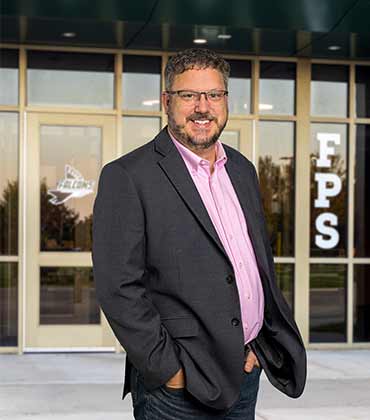
Some school district decisions are difficult in the moment, even when they are necessary for the future. As superintendent of Faribault Public Schools, Jamie Bente has learned to consider both the district’s immediate needs and the decisions that will serve students, staff, and families years from now.
Bente says the move from high school principal to superintendent changed the way he thinks about time. As a principal, much of his attention was on the current school year and the next one. As superintendent, he must also look three, five, seven and even 10 years ahead, making decisions that will position the district for the future.
A Career Built One Step at a Time
Bente did not always plan to work in education. Growing up, he imagined joining one of his grandfathers in a small business or on a farm. His mother encouraged him to go to college, and while he was there, both grandfathers passed away. He began thinking more seriously about his future and eventually found his way into teaching.
Early in his career, Bente worked part-time as a teacher and substitute teacher and served as a substitute paraprofessional. He taught social studies and history and coached football and track. Those experiences gave him a perspective on the many roles that contribute to a school community.
He enjoyed the work, but after several years, he began to feel that he could contribute in a different way. He returned to school and earned his master’s degree in educational leadership, as well as his principal’s and superintendent’s licenses, through Saint Mary’s University.
While pursuing his graduate education, Bente became a high school dean of students at Richfield Public Schools, a first-ring suburb of Minneapolis. After three years as dean, he came to Faribault Public Schools as assistant principal at Faribault High School. He served in that role for three years before becoming high school principal, a position he held for six years. He is now in his fifth year as superintendent of the district.
Partnerships That Open Doors
One of Bente’s most memorable experiences as principal grew out of a partnership that helped two students see a path to college.
The students were part of Faribault High School’s AVID program and hoped to become teachers. Both had worked hard to secure scholarships, but each was still about $5,000 to $6,000 short of what they needed.
Through a relationship Bente had developed with Minnesota State University, Mankato, he learned that the university wanted to prepare teachers who might one day return to Faribault. When university representatives asked whether he knew students who needed help, he told them about the two young women.
About 10 minutes before Bente was scheduled to speak at a signing-day event, the university offered to cover the remainder of their college costs. He shared the news with the students in front of their peers.
The emotion of that moment has stayed with him. It also showed him what can happen when schools build relationships with outside organizations that want to support students. As he considered moving into the superintendency, Bente saw an opportunity to build more of those partnerships across the district.
His family has also supported students through scholarships for young people preparing for what Faribault calls “life after high school.”
“To me, academics take a back seat to the social and emotional stability and growth of our students.”
Planning for the District’s Future
Becoming superintendent broadened Bente’s focus from one high school to the district’s schools and programs, serving learners from three-year-olds through adult students.
It also meant making decisions about the district’s long-term structure. Faribault reorganized its elementary schools, creating a pre-kindergarten and kindergarten center and combining its elementary schools into two sites serving students in grades one through five.
The changes were difficult in a community where neighborhood schools had long been part of the local identity. Bente understood the importance of that tradition, but he also believed the existing structure would become increasingly difficult to sustain over the next five to 10 years.
The decision required him to think beyond what felt comfortable in the moment and consider what the district would need in the years ahead. As superintendent, he says, some decisions may be difficult today but put the district in a stronger position for the future.
Giving Educators Room to Lead and Grow
Bente’s approach to leadership begins with hiring strong people and giving them the support they need to do their jobs.
He says he does not view himself as the expert in every area of district operations. Instead, he works to hire capable leaders, provide resources, share his experience, and give them room to lead. Faribault’s Playbook helps establish a shared understanding of the district’s identity, purpose, work, and measures of success. Bente uses it when recruiting employees and throughout their work in the district.
He brings a similar approach to developing teachers and support staff. Drawing on his experience as a teacher, Bente says every setting can be viewed as a classroom. Just as students have different strengths and needs, educators are at different points in their careers and need different kinds of support.
Whether someone is a first-year teacher or a veteran educator, Bente believes there is always room to grow. He encourages leaders to understand where each person is, establish shared goals, and identify the support that will help them reach the next level. That investment in adults, he says, ultimately benefits students.
Meeting Students’ Needs
For Bente, helping students succeed academically begins with making sure they feel safe, supported, and ready to learn.
“To me, academics take a back seat to the social and emotional stability and growth of our students,” he says.
He believes students need their basic needs met, including food and clean clothes, and need to know there are caring adults at school whom they can trust. Those relationships help students grow socially and emotionally and provide a foundation for academic learning.
Bente sees those needs reflected in the expanding role of public schools. Faribault provides free breakfast and lunch to students and offers dinner services to many families through community school grants. For some families, the district is a source of three meals a day, five days a week. Schools also help address students’ physical and mental health needs.
Those services are important to families and communities, Bente says, but they add responsibilities at a time when public funding has not kept pace. As a result, districts may have to redirect resources that would otherwise support academic programs.
Keeping Perspective in a Changing Profession
During Bente’s career, classroom technology has continued to evolve. Chalkboards gave way to whiteboards and smartboards, followed by one-to-one devices, cell phones, and now artificial intelligence.
He views each as a tool that educators and students must learn to use effectively. Technology can help people work and learn, he says, while students continue to do the thinking and learning themselves.
Bente remembers similar concerns when the internet became more common in education in the early 2000s. At the time, some worried that easy access to information would weaken learning. He sees a familiar pattern with new technology. People often focus first on potential harm before learning how the tool can help.
Maintaining perspective also matters in leadership. When hiring principals and cabinet-level directors, Bente tells them that their jobs can consume their lives if they allow it. He encourages them to make time for their faith, families, and themselves.
For Bente, setting boundaries helps him return to work ready to serve the district and remain present as a husband and father.
Encouraging the Next Generation of Leaders
Bente knows that school leadership brings challenges and sacrifices, and he recognizes that the work is not for everyone. He also believes it offers meaningful opportunities for educators who want to make a broader difference.
Looking back, he describes his time as a teacher, assistant principal, principal, and superintendent as several different careers within education. After about eight years of teaching and coaching, he began wondering what the next decade might hold. That question led him to explore leadership.
His advice to educators considering a similar step is to explore the opportunities available and understand that leadership brings both challenges and rewards. Public education, he says, needs dedicated leaders willing to take on that work.
From building partnerships to making long-term decisions for Faribault, Bente’s career reflects his commitment to creating opportunities for students and supporting the people who serve them. That work has contributed to his recognition as the School Superintendent of the Year in Minnesota 2026.

Get the best of Education Insider delivered directly to you.
