


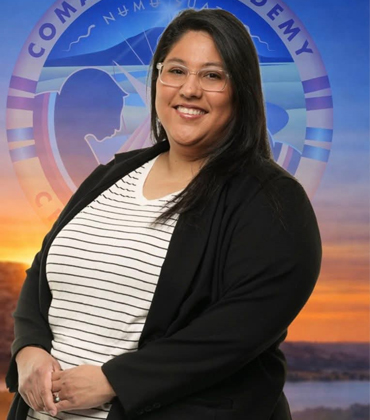
 Shannon Foye, Principal
It is a tribally authorized public charter school serving pre-K through fifth grade. Most students are Native American, and the school day blends academics with daily Nʉmʉ language instruction and Comanche cultural practice. The academy stays small on purpose, built around relationships between students, families and elders.
For families in Lawton, that work carries particular weight. Many connected to the academy carry histories of forced removal, boarding schools and lost language. Principal Shannon Foye has built a school where children inherit something different.
“Many of our grandparents and great-grandparents were forcefully removed from their homes and had to deal with colonization,” says Foye. “Now these children just embrace who they are, and they don’t know there was ever a world where we weren’t allowed to be proud of our heritage.”
A Foothold for Generations
Nʉmʉ runs through everyday academics, not beside it. An English lesson opens into a Comanche story. A science lesson on dinosaurs becomes a lesson in body parts. A nature walk becomes a lesson in naming plants and animals in Nʉmʉ.
Morning ceremonies deepen that connection. Students honor the four directions, pray, recite the Lord’s Prayer and Pledge of Allegiance in Comanche, sing the school song and speak the school creed, building what Foye calls “a foothold for generations to come.” Comanche Language Department teachers and elders turn the language into games, songs and lesson plans.
-
Many of our grandparents and great-grandparents were forcefully removed from their homes and had to deal with colonization. Now these children just embrace who they are, and they don’t know there was ever a world where we weren’t allowed to be proud of our heritage.
That foothold reaches past the classroom and into the home. Monthly literacy nights open classrooms to families, built around rotating books, themes and character traits, with the PTA, the Comanche Nation and elders taking part. Families pick up library cards and hear stories from elders on the same evening. Cultural nights carry that spirit further. Families craft, bead, drum, sing and eat together, passing regalia, dance and song hand to hand between generations.
Theatre, media club, culinary class and sports round out the school day, each one building confidence and friendship.
Caretakers of Now
Through a partnership with the Kiowa, Comanche and Apache program, students visit the grounds of the former Fort Sill Indian Boarding School, now reclaimed for gardening, beekeeping and honey-harvesting lessons taught by elders.
“We are not above nature, we are not different from nature, but we are a part of nature,” says Foye. “Others have walked before us, and we are just the caretakers of now, for the future generation to inherit this earth.”
Where No Child Stands Alone
Before- and after-school care, a summer program, and response-to-intervention support give teachers more time with each child. A wellness class teaches students to name big feelings, breathe through them and choose how the rest of their day goes.
That same care extends to families. When one family lost a loved one unexpectedly, staff attended every event, organized meals and stayed present long after the funeral. Staff show the same presence at birthdays and honor dances.
Building the Next Foothold
“We want them to feel confident, included and cherished,” says Foye. “For us, it is knowing that a child feels confident in themselves and believes in their ability, and that is success for us.”
Teachers are leading data-driven planning through PLCs, and a language grant from the Office of Indian Education will fund family language nights at every grade. A new makerspace STEM lab, a Lego club and e-games will widen after-school options.
EducationInsider’s recognition of Comanche Academy Charter School as Top Charter School 2026 reflects what Foye and her staff are building, academic rigor and cultural belonging growing side by side.

